Vidyarambham: A Child's First Letters in Rice
Vidyarambham is when a child writes first letters in a plate of rice on Vijayadashami. What the ritual means, how families do it, and how to hold it anywhere.
· 4 min read
In short
Vidyarambham is the ritual where a young child writes their first letters, usually in a plate of rice, on Vijayadashami.
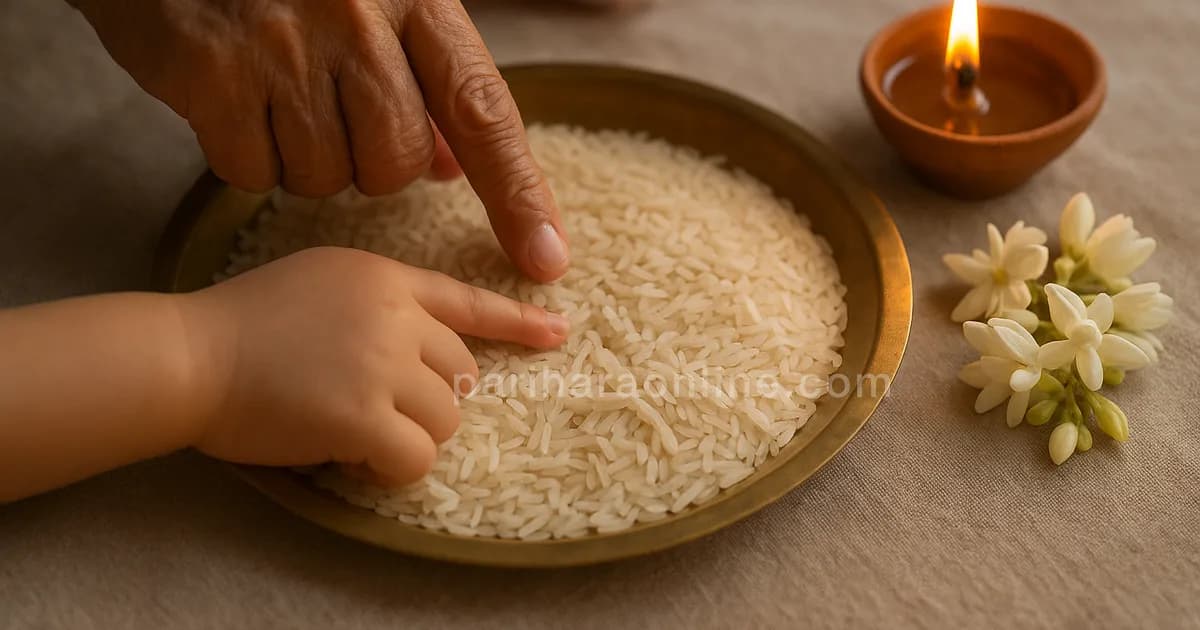
An elder or teacher guides the child's finger, often starting with Om or the name of Ganesha or Saraswati.
Adults also use the day to begin music, dance or any new learning.
Vidyarambham is the ceremony in which a small child writes their first letters, usually in a plate of rice, on the morning of Vijayadashami. My nephew was not quite three when his turn came. He sat on his grandmother's lap on the floor of her Palakkad house, and she held his index finger in hers and moved it through the grains: the syllable Om, and then the first letter of the alphabet. His finger shook. He looked up at her halfway through, as if to ask whether he was allowed to spoil such a neat plate of rice. She nodded, and he went on. That nod is, to me, the whole ritual. A family is telling a child that learning is sacred, and that he is welcome in it.
What is vidyarambham?
The word joins vidya, knowledge, and arambham, beginning. In Kerala the ritual is also called ezhuthiniruthu, which means, roughly, "seating a child to write", and ezhuthiniruthu meaning captures the tenderness of it: someone has to sit the child down and sit with them. It is strongest in Kerala and parts of Tamil Nadu and Karnataka, where temples and homes fill with families on the tenth day after the nine nights of Navratri.
The timing is deliberate. The last days of Navratri belong to Saraswati, the Goddess of learning, and books and instruments are placed before her and left untouched during Saraswati puja and Ayudha Pooja. On Vijayadashami, the day of victory, the books are taken back and the first new thing is learned. A child's first letters are the most tender version of that return. If you want to know why the festival builds to this point over nine nights, why Navratri lasts nine nights tells the story.
How is the first-letters ritual done?
It is short. A grandparent, teacher, priest or respected elder sits facing east with the child on their lap. The tools are worshipped first: the plate of rice, a slate or palm leaf, a pen or stylus, all placed before Saraswati or Ganesha. The reason is simple enough to explain to a child. We bow to the things that will teach us before we use them.
Then the guiding begins. Writing in rice on Vijayadashami, the elder holds the child's finger and traces a line such as "Om Hari Sri Ganapataye Namah" or the first letter of the family's language. In many families a gold ring is dipped in honey and the same syllable is written gently on the child's tongue, so that speech itself is blessed. The child may cry. Mine laughed at the honey. A sweet is given, the rice is later cooked or offered, and the day is marked.
The Tirukkural, in its chapter on learning, says: learn thoroughly what should be learned, and then live by it. I thought of that couplet watching my nephew, because the ritual is really about the second half. Nobody expects a three-year-old to learn thoroughly. We are asking him to grow into a person who lives by what he learns.
Vidyarambham far from home
A vidyarambham ceremony at home, far from Kerala, needs very little. A kitchen table works as well as a temple floor: a clean plate, uncooked rice, a lamp, a picture of Saraswati. The person who guides the hand matters more than the place. When grandparents cannot travel, many families set up a laptop at child height so a grandmother in Thrissur can speak the syllables while a parent in Texas guides the finger. The practical side of that, including the time-zone arithmetic, is covered in joining a puja across time zones.
Adults take part too. In Kerala, it is common to see grown men and women at the temple on Vijayadashami, beginning music, dance, a new language or a new trade on the same morning. Students preparing for exams often keep this day for their first page of revision, a habit that sits comfortably beside a simple prayer before exams. The two goddesses of learning, and how families pray to them, are introduced in Saraswati and Hayagriva.
One small thing to carry into the week
Whatever your age, pick one thing you have been meaning to learn. On Vijayadashami, or on any morning that feels like a beginning, pour a little rice onto a plate and write its first word with your finger. Then begin, with someone's nod, even if it is only your own.
Questions people ask
What is vidyarambham and why is it done on Vijayadashami?
Vidyarambham means the beginning of learning. On Vijayadashami, the day after Saraswati is worshipped during Navratri, young children are introduced to letters by writing in rice or sand. The day is considered auspicious for beginnings because it marks victory and knowledge together. It is widely observed in Kerala and in many Tamil and Karnataka homes.
How do you do a vidyarambham ceremony at home?
Place a plate of raw rice before a lamp and a picture of Saraswati or Ganesha. An elder sits the child on their lap, holds the child's index finger and writes a sacred syllable such as Om, then the first letters of the alphabet. Some families gently trace a letter on the tongue with a gold ring. Close with a sweet.
At what age is vidyarambham done?
Most families do it between two and five years old, before formal schooling begins. There is no strict rule, and some wait until the child can sit still happily. Adults also mark the day by starting music, dance, a new language or any skill, because the ritual honours beginnings in learning rather than a particular age.
What is ezhuthiniruthu?
Ezhuthiniruthu is the Malayalam name for vidyarambham, meaning sitting down to write. In Kerala, children are brought to temples, schools or elders' homes on Vijayadashami to write their first letters in rice or sand. It is one of the most loved family rituals of the season and is often photographed and remembered for years.
Enjoying this?
To get more Vidyarambham posts like this, subscribe for free.
Written by
The Sunday column: festivals and rituals meeting ordinary weeks
Manikandan writes the Sunday column, where festivals and rituals meet commutes, hospital corridors and video calls with parents far away. Each piece closes with one small thing to carry into the week ahead.