Why Navratri Lasts Nine Nights: The Story Behind It
Why Navratri is nine days: the Devi Mahatmyam story, the three goddesses, the nine forms of Durga, and what each night asks of you at home today.
· 5 min read
In short
Navratri lasts nine nights because the Devi Mahatmyam describes the Goddess battling Mahishasura for nine nights and winning on the tenth, Vijayadashami.
The nine nights are often grouped in threes: Durga for strength, Lakshmi for abundance, Saraswati for wisdom, a slow movement from courage to clarity.
Sharad Navratri begins with the new moon of Ashwin, usually in September or October, as the nights grow longer.
Navratri lasts nine nights because, in the popular telling of the Devi Mahatmyam, the Goddess fights the buffalo demon Mahishasura for nine nights and wins on the tenth day. That is the short answer to why Navratri is nine nights. The longer answer is hidden in the story itself. The demon does not fall in a single blow. He changes shape, he retreats, he returns. The story says a goddess needed nine nights to finish a fight. The story is really about how long it takes to turn around a stubborn mind.
Why is Navratri nine days long?
The Devi Mahatmyam, a set of seven hundred verses within the Markandeya Purana, begins with the gods in trouble. Mahishasura has won a boon that no god can kill him, and he has taken over heaven. The gods complain, grow angry, and from that anger a light pours out of each of them. The lights gather into one form: the Goddess, carrying every god's weapon in her many arms.
She rides out on a lion. The buffalo demon becomes a lion, then a man with a sword, then an elephant, then a buffalo again. Every time she strikes, he slips into a new shape. Tradition counts the battle across nine nights, and the victory arrives on the tenth, Vijayadashami, "the tenth day of victory".
Notice what the story does not say. It does not say the Goddess was weak for eight nights. It says the demon was slippery. Anyone who has tried to give up a habit knows this demon: cornered on Monday, reasonable again by Wednesday. Nine nights is the length of an honest effort, long enough for the shape-shifting to run out of shapes.
Three goddesses, three nights each
Many families, especially in the south, read the nine nights as three sets of three. The first three belong to Durga, fierce and protective, who clears away what blocks us. The middle three belong to Lakshmi, who brings abundance and steadiness. The last three belong to Saraswati, who brings learning and clarity. Strength first, then prosperity, then wisdom. The order matters. Wisdom that arrives before strength tends to become an excuse.
In the north, each night honours one of the nine forms of Durga, called the Navadurga: Shailaputri, daughter of the mountain; Brahmacharini, the one who practises austerity; Chandraghanta, with the crescent moon like a bell; Kushmanda, who smiled the cosmos into being; Skandamata, mother of Skanda; Katyayani, the warrior; Kalaratri, the dark night; Mahagauri, the radiant; and Siddhidatri, the giver of accomplishment.
Both groupings are traditional. Neither is the correct one. They are two maps of the same journey, and families keep the map their grandmothers used. If your household fasts through these nights, the Navratri fasting rules and what they are for will help you choose a version that suits your body.
Why Navratri is nine nights in the dark half of the year
Sharad Navratri, the autumn Navratri, begins the day after the new moon of the lunar month of Ashwin, usually in late September or October. Check the current year's panchangam, the traditional Hindu almanac, for the exact start in your city. The timing is not accidental. The monsoon has ended, the harvest is coming in, and the nights are growing longer. The sun is in its southward journey, which the tradition calls the dark half of the year.
Festivals of light and courage tend to arrive exactly when the light is thinning. That is why Navratri is followed by Dussehra, and Dussehra by Deepavali. The calendar seems to know that people need encouragement before winter, and it tells a story of a Goddess who does not give up. You can read how the tenth day carries that story forward in the meaning of Dussehra and the burning of Ravana, and how the ninth day turns to tools and books in the meaning of Ayudha Pooja.
One lamp, one quality, each night
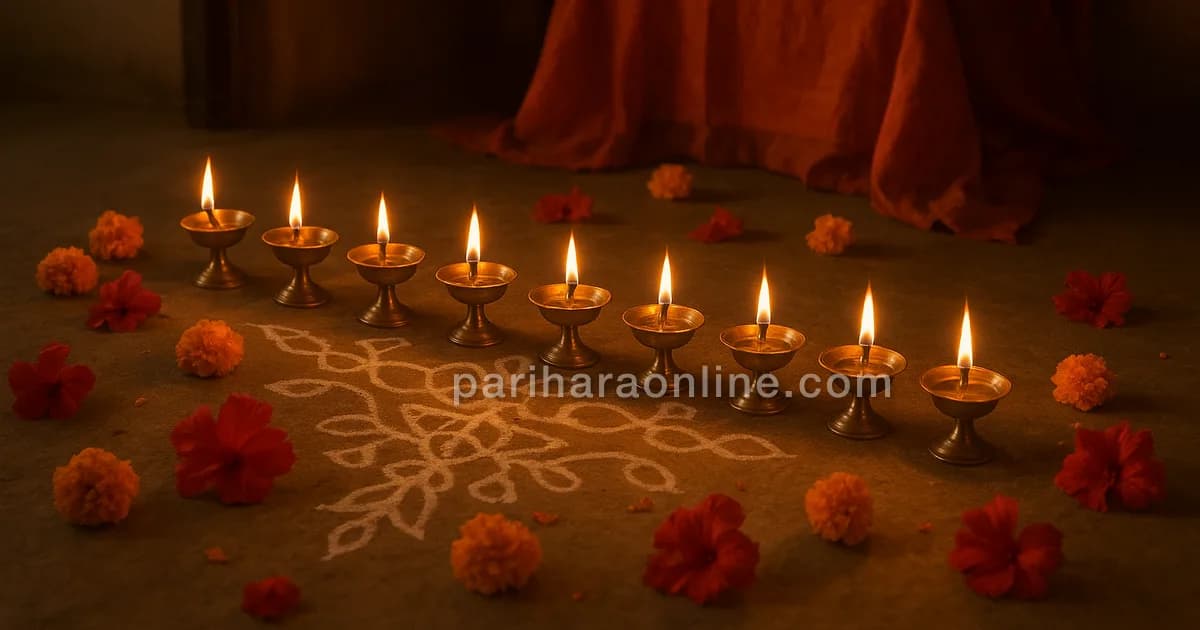
You do not need a temple or a priest to keep these nine nights. Pick one form of the Goddess for each night, or simply follow the three-by-three pattern. Light one lamp at dusk; if you want to know why that small act has lasted so long, read why Hindus light lamps. Sit with it for a few minutes and ask which quality you most need this season: strength, steadiness or clarity.
If you live far from India, the nights still work on a weekday schedule, after dinner and before homework; there is a guide to celebrating Navratri in the USA for exactly that. The demon, the story reminds us, never quite dies, which is why the festival returns every autumn. Nobody is keeping score. The nine nights are simply a chance to notice which shape your own buffalo is wearing now.
Questions people ask
Why is Navratri celebrated for nine days and not seven or ten?
The Devi Mahatmyam, part of the Markandeya Purana, tells of the Goddess fighting the buffalo demon Mahishasura over nine nights. The tenth day, Vijayadashami, marks her victory. Many families also read the nine nights as three sets of three, honouring Durga, Lakshmi and Saraswati in turn, which gives the festival a natural rhythm of strength, prosperity and wisdom.
What are the nine forms of Durga worshipped in Navratri?
In the north Indian tradition the nine forms, or Navadurga, are Shailaputri, Brahmacharini, Chandraghanta, Kushmanda, Skandamata, Katyayani, Kalaratri, Mahagauri and Siddhidatri, one for each night. South Indian homes often follow the Durga, Lakshmi, Saraswati grouping instead. Both are traditional; you can follow whichever your family knows, or simply honour the Goddess as one each evening.
When does Sharad Navratri start each year?
Sharad Navratri begins on the first day after the new moon of the lunar month of Ashwin, which usually falls in late September or October. Because the Hindu calendar is lunar, the exact start moves every year. Check the current year's panchangam for your city, since the tithi can shift by a day between India and the United States.
What does the Mahishasura story actually mean?
Mahishasura was a buffalo demon who could change shape and could not be defeated by any god. The story says only the combined power of all the gods, gathered into one Goddess, could stop him. Read symbolically, he is the dull, stubborn, shape-shifting part of us, and the Goddess is focused energy that finally refuses to negotiate with it.
Enjoying this?
To get more Navratri posts like this, subscribe for free.
Written by
Reads the old stories for what they still mean
Hariharan writes about the myths, symbols and festival stories that most of us grew up hearing but were rarely asked to think about. He tells the story first, then asks what it is really about, and leaves the conclusion to you.