Dussehra Significance: Ravana and What the Burning Means
Dussehra significance, told through Ravana and Durga: why the tenth day marks victory, what burning the effigy means, and why Ravana is more than a villain.
· 4 min read
In short
Dussehra, or Vijayadashami, marks two victories: Rama over Ravana in the Ramayana, and Durga over Mahishasura in the Devi Mahatmyam, on the tenth day after Navratri begins.
Ravana is burned not because he was ignorant but because he was brilliant and arrogant; the effigy stands for knowledge that forgot humility.
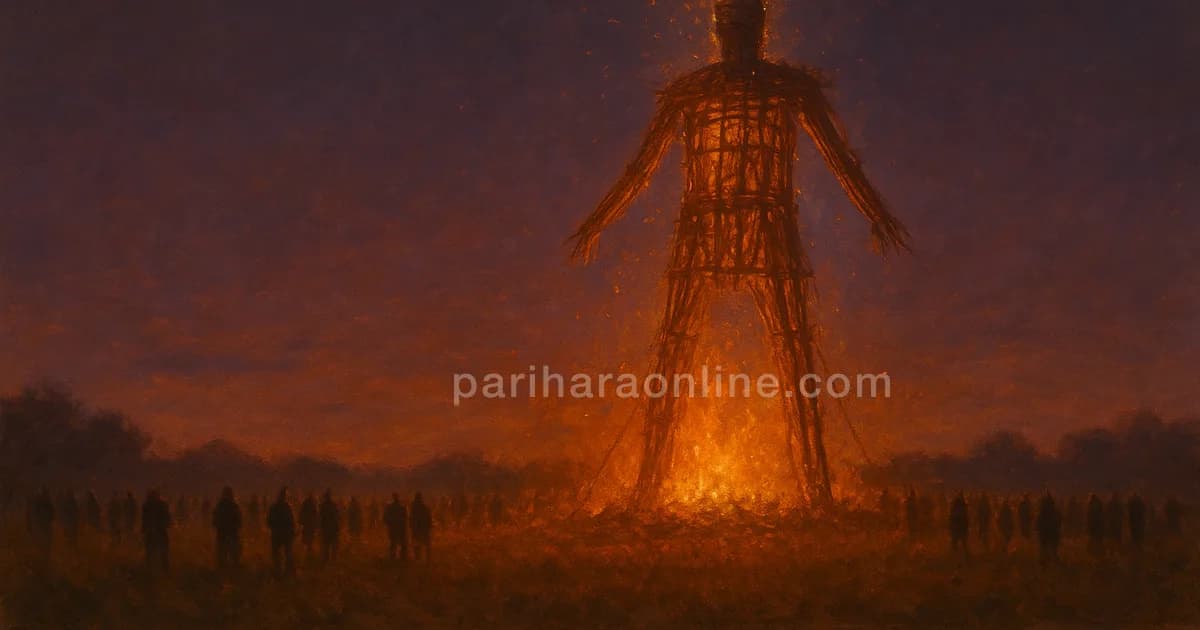
On Dussehra, towns across north India build a towering figure of a ten-headed man, pack it with fireworks and set it alight at dusk. The man is Ravana, and the story says he was a great scholar, a gifted musician and a devoted worshipper of Shiva. So what exactly are we burning? The Dussehra significance lies in that question. The festival marks the victory of Rama over Ravana and of Durga over Mahishasura, but the figure in the flames is less an enemy outside than a warning about what learning becomes without humility.
Why is Dussehra celebrated?
Two stories meet on this one day, the tenth day after the nine nights of Navratri.
The first is from the Ramayana. Ravana, king of Lanka, carries Sita away. Rama, his brother Lakshmana and an army of monkeys and bears led by Hanuman cross the sea to bring her back. After a long war, Rama's arrow finds Ravana, and the tenth day becomes the day of that victory. In some tellings, such as the Bengali Ramayana of Krittivasa, Rama first worships the Goddess before the final battle, which is how the two festivals knot together.
The second is from the Devi Mahatmyam, where the Goddess defeats the buffalo demon Mahishasura after nine nights of battle; you can read that story in why Navratri lasts nine nights. The tenth day is called Vijayadashami, "the tenth day of victory", and in the east and south the Goddess is the centre of it.
Two heroes, two demons, one day. The calendar is not confused. It is saying the same thing twice, in case we missed it the first time.
Dussehra significance: what the ten heads stand for
Here is the odd part. Ravana is not a brute. The tradition credits him with mastery of the Vedas, of music and of medicine. A popular story says he composed a hymn to Shiva so beautiful that Shiva forgave him for trying to lift Mount Kailasa. He is, by most accounts, the most learned person in the Ramayana.
And yet. He cannot hear the word "no". He wants Sita, so he takes her. His own brother Vibhishana warns him, and he throws his brother out. All that learning, and none of it reached the part of him that wanted.
The ten heads are often read as ten passions: desire, anger, delusion, greed, pride, jealousy, and the mind, intellect, will and ego when they run without restraint. Other families read them as the ten senses turned outward. The number matters less than the image. A man with ten heads has ten voices, all talking, all certain. The story says Rama had to cut the heads again and again because they kept growing back. The story is really about how a clever mind can argue for anything.
So when the effigy burns, we are not celebrating the death of a scholar. We are watching arrogance go up in smoke, and hoping some of ours goes with it.
Vijayadashami as a beginning
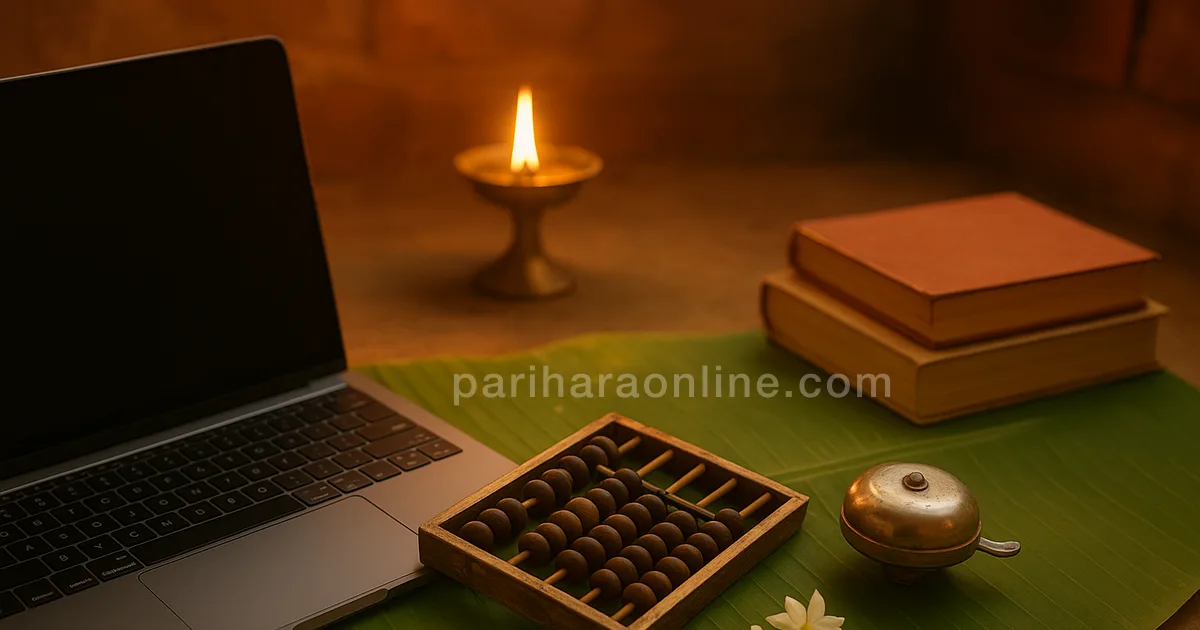
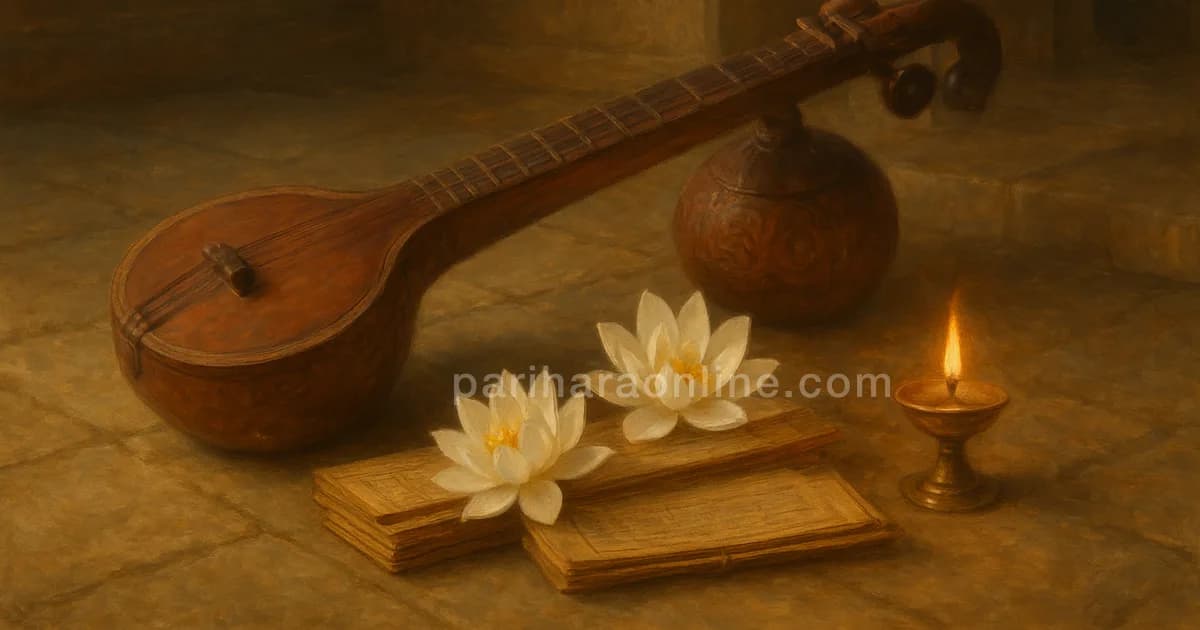
The tenth day is not only an ending. In the south it is one of the most auspicious days to begin something. Children are brought to write their first letters in rice or sand, a ceremony called Vidyarambham, the beginning of learning. Musicians and dancers start new students. In Maharashtra and Karnataka, people exchange leaves of the shami tree as tokens of gold, remembering the Pandavas, who hid their weapons in a shami tree and found them there when they returned, a story told more fully in the meaning of Ayudha Pooja.
The pairing is wise. Having watched what learning without humility looks like, we begin learning again, this time on our knees before Saraswati. If a student in your house is starting something new, Saraswati and Hayagriva, the deities of learning makes a good companion read. In some homes, the Navratri worship of young girls as the Goddess, explained in Kanya Puja and its meaning, comes just before, which is its own lesson in humility.
One head to put down
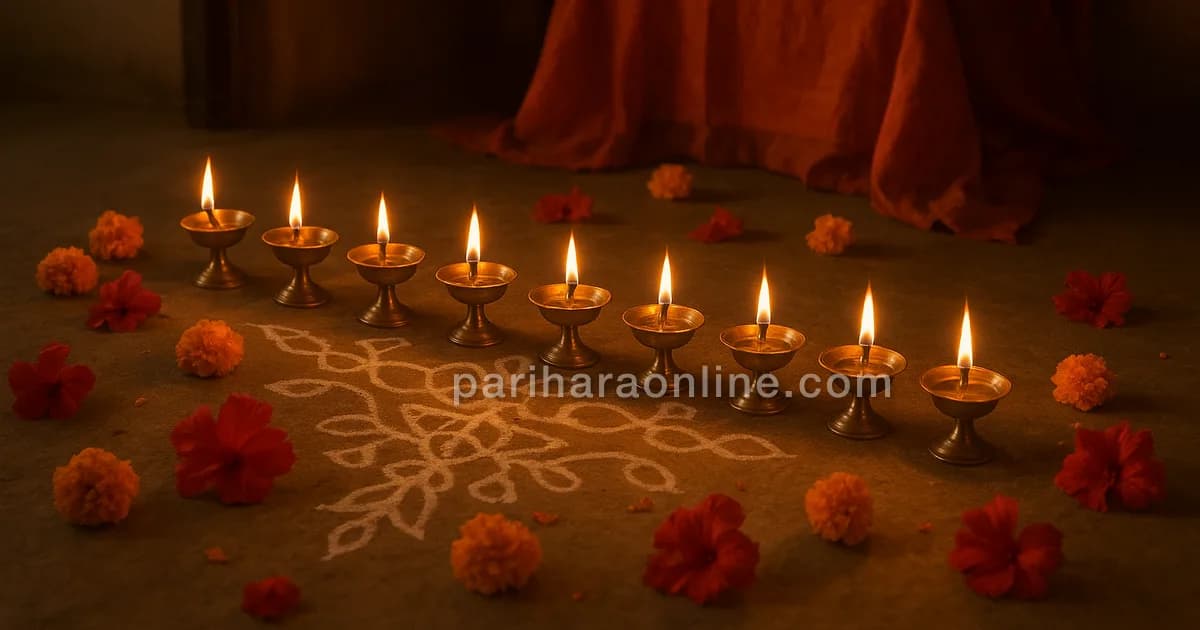
You do not need to burn an effigy to keep Dussehra. Try something smaller. Name one of your ten heads, the one that talks loudest: the anger that arrives on the drive home, the pride that will not apologise, the want that will not wait. Write it on a piece of paper and, if you can do it safely, burn it in the lamp.
Then begin one small new thing on Vijayadashami: a book, a practice, a letter to someone. The victory the story describes is not a single arrow. It is quiet, and it has to be won again most days.
Questions people ask
Why is Dussehra celebrated?
Dussehra celebrates victory. In north India it marks Rama defeating Ravana, as told in the Ramayana, and effigies of Ravana are burned. In Bengal and much of the east it closes Durga Puja, marking the Goddess's victory over Mahishasura from the Devi Mahatmyam. In the south it is Vijayadashami, an auspicious day to begin learning, music or new work.
What do Ravana's ten heads symbolise?
Traditionally the ten heads show Ravana's vast learning; he was said to know the four Vedas and six shastras. Later teachers read them as ten weaknesses such as lust, anger, greed, pride, jealousy and attachment. Either way the point is similar: great capacity without humility becomes dangerous. Burning the effigy is a public reminder to burn those tendencies privately.
Is Vijayadashami the same day as Dussehra?
Yes, they are two names for the same festival, the tenth day of the bright half of Ashwin, right after the nine nights of Navratri. Some regions observe it a day apart depending on when the Dashami tithi falls. Check the current year's panchangam for your city if you want the precise day and the auspicious Vijay muhurat.
Enjoying this?
To get more Dussehra posts like this, subscribe for free.
Written by
Reads the old stories for what they still mean
Hariharan writes about the myths, symbols and festival stories that most of us grew up hearing but were rarely asked to think about. He tells the story first, then asks what it is really about, and leaves the conclusion to you.