Kataka Rasi (Cancer): The Moon's Sign and Its Poojas
Kataka rasi, the Moon's own sign: the crab, the nature tradition describes, the story of the crescent on Shiva's head, and the Thingalur temple link.
· 4 min read
In short
Kataka rasi is the fourth sign in Jyotish and the Moon's own, symbolised by a crab; rasi itself means the sign the Moon occupied at birth.
Tradition describes Kataka natives as nurturing, loyal and sensitive, with moodiness as the shadow.
Thingalur, the Chandra temple, and Monday Shiva or Parvati worship are traditionally linked with Kataka through its ruling planet.
The Moon, cursed to waste away, ran to Shiva for shelter, and Shiva placed the thin remaining crescent in his hair. Kataka rasi is the Moon's own house, and that story is the best way into it. Kataka's symbol is a crab: a hard shell around something very soft. The story of the crescent is about exactly that arrangement.
What is Kataka rasi, and why is it the Moon's own?
Kataka rasi is the fourth of the twelve signs. Rasi, in Jyotish, points to the Moon: the sign it was crossing at the moment you were born. It holds the last quarter of Punarvasu, all of Pushya, the nourishing star and all of Ashlesha. Its ruling planet is Chandra, the Moon, and it is the only sign the Moon owns; every other planet except the Sun rules two. Western astrologers call the sign Cancer, measuring it from the seasons rather than the stars.
Why should that matter? Because in Jyotish the Moon is the mind: feeling, memory, mood, the part of us that waxes and wanes. A sign ruled by the Moon is a sign where feeling is at home. And the crab, armoured outside and tender inside, is the tradition's picture of how feeling survives in the world.
The crescent on Shiva's head
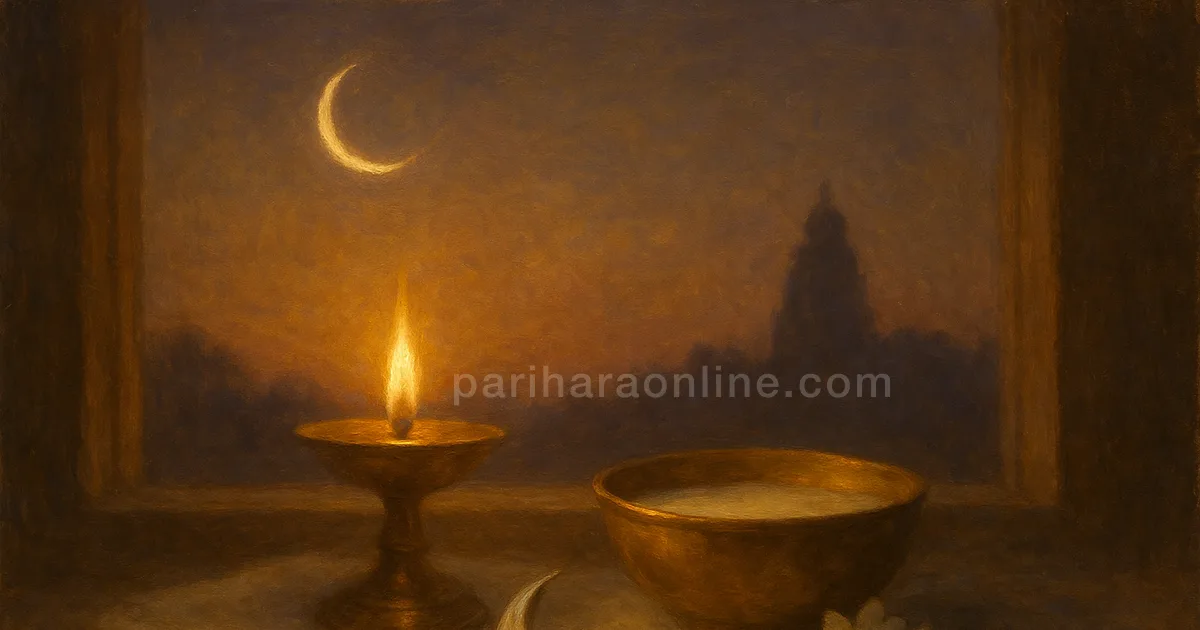
The curse came from Daksha, whose twenty-seven daughters, the nakshatras, were all married to the Moon; Chandra neglected the rest for one of them, and the full quarrel is told under Rohini, the Moon's favourite. What matters for Kataka is what happened next. The Moon began to shrink, night after night. In terror he went to Shiva, who could not undo a curse but could soften it. He took the thin crescent that remained and set it in his matted hair. From that day the Moon wanes and then waxes again, forever. Shiva is called Chandrashekhara, "the one who wears the Moon as a crest", because of this story.
The story says the Moon was saved. The story is really about how feeling is protected. Shiva does not harden the Moon or remove the curse. He keeps it close to his head, where it can recover. Feeling is not cured of its waning. It is held, and so it returns.
So the tradition pictures Kataka as nurturing, loyal, protective, deeply attached to home and family, and prone to moods that come and go like the Moon's phases. The risk is the shell grown too thick, the crab that will not come out. These are tendencies the tradition noticed, not verdicts. The crescent is not a flaw. It is a phase.
Thingalur, Mondays and a crab that prayed
The Moon's own temple is at Thingalur, near Thiruvaiyaru, counted among the Navagraha shrines, where the Moon is said to have worshipped Shiva. Monday is the Moon's day, the day of Chandra worship, and Monday worship of Shiva, the one who wears the crescent, is the natural practice for the sign; many families keep a light Monday fast, the Somvar vrat, for the same reason.
Parvati and the many forms of Ambal, the Mother, sit close to Kataka as well, because of the sign's mothering nature. And there is a charming local story at Thirunthudevankudi, near Kumbakonam, where a crab is said to have worshipped Shiva every day and been blessed for its devotion. The Karkadeswarar temple there takes its name from the crab.
The next sign, Simha, the Sun's own house, makes a good counterpart: one sign for the Moon, one for the Sun.
A steady corner
The crab carries its home on its back. It does not need a house because it is one. That is not a bad image for anyone who has moved far from where they grew up.
If your Moon is in Kataka, make one small corner of home steady this week. A lamp, a chair, a photograph. A Monday evening call to someone you love. Let the shell be a shelter, not a wall.
Questions people ask
Which god should Kataka rasi people worship?
Because Chandra rules Kataka, Monday worship of Shiva, who wears the crescent moon, is the most common practice. Many families also pray to Parvati or the Goddess as mother, fitting the sign's nurturing nature. Thingalur, the Chandra shrine among the Navagraha temples, is traditionally linked to the sign. Keep the practice simple and regular.
What are Kataka rasi characteristics?
Tradition describes people with the Moon in Kataka as caring, protective, imaginative, loyal to family and deeply feeling, with moodiness or over-sensitivity as possible shadows. Because the Moon rules its own sign here, emotions are said to run strong. These Kataka rasi characteristics are tradition's portrait of the Moon sign, not fixed traits or predictions.
Which temple is linked to Kadagam rasi?
Kadagam, the Tamil name for Kataka, is traditionally linked with Thingalur, near Thiruvaiyaru, where Chandra is worshipped among the Navagraha temples. The Karkadeswarar temple at Thirunthudevankudi, whose name recalls the crab, is also associated with the sign in popular lists. These links come through the ruling planet and symbol, and customs vary by region.
Enjoying this?
To get more Rasi posts like this, subscribe for free.
Written by
Reads the old stories for what they still mean
Hariharan writes about the myths, symbols and festival stories that most of us grew up hearing but were rarely asked to think about. He tells the story first, then asks what it is really about, and leaves the conclusion to you.