Kolam and Rangoli Meaning: Drawing at the Doorstep
Rangoli meaning goes beyond decoration: why South Indian homes draw kolam at the doorstep each dawn, why rice flour feeds ants, and what the lines are about.
· 5 min read
In short
Rangoli and kolam are drawn at the doorstep to welcome guests and the goddess Lakshmi, marking the threshold as a place of care.
Traditional kolam uses rice flour so ants and birds can eat it, making the design a small daily act of feeding other beings.
The drawing is meant to be temporary; being walked over and redrawn each dawn is part of its meaning.
Rangoli meaning, at its simplest, is a welcome drawn at the doorstep. In a Tamil street at dawn, women bend over the swept and sprinkled ground and draw a kolam in white rice flour, knowing it will be walked over, blown about and gone by evening. Ask why, and the answer is usually, "So Lakshmi will come in." The drawing is said to invite the goddess of wellbeing. What it also records is how a household chooses to begin its day: with a small, generous, beautiful act placed exactly where the home meets the world.
Rangoli meaning: a welcome drawn at the threshold
Every house has a line where the street ends and the family begins. Indian stories take that line seriously. Narasimha, in the Bhagavata Purana, kills Hiranyakashipu on a threshold, neither inside nor outside, at dusk, neither day nor night; the whole tale is in the story of Prahlad and Holi. The threshold is where rules loosen and anything can walk in, which is exactly why it is worth tending.
So the drawing sits there. It is not hung on a wall for the family to admire. It lies on the ground for whoever arrives: the milkman, a neighbour, a guest, the goddess. A kolam at the door says the house is awake and has made itself ready. A missing kolam, in many villages, quietly told neighbours that the family was in mourning. The drawing was a message as much as a decoration.
This is why people ask why draw rangoli at the entrance and not somewhere safer. The answer is that safety is not the point. The point is the welcome.
Why is kolam made with rice flour?
The traditional kolam is drawn with rice flour, and the rice flour kolam significance is almost too simple to state: ants eat it. So do sparrows and crows. Before the family has eaten, before the coffee is poured, a handful of grain has already been given away to the smallest creatures in the lane. Kolam meaning, in this light, is feeding. The first act of the day is not taking but offering.
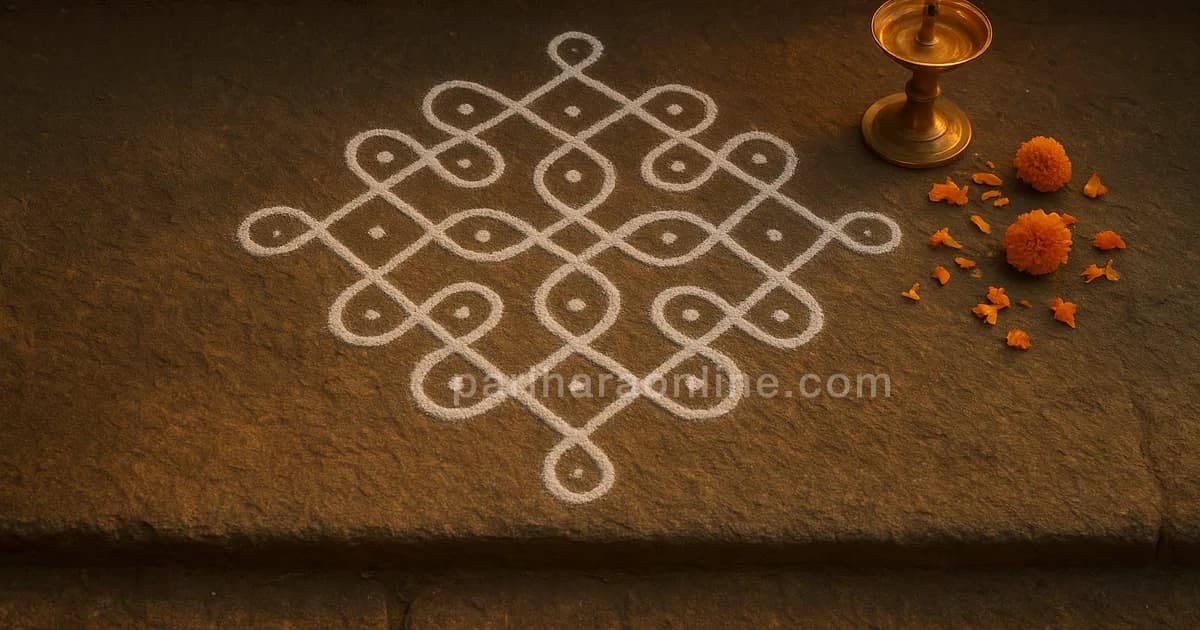
Then there is the grid. Most kolams begin with dots, pulli in Tamil, laid out in rows. The lines then loop around the dots, sometimes in a single continuous stroke that never lifts from the ground. It is hard not to see a picture of life in it: a scatter of fixed points you did not choose, and a line of your own drawn gracefully around them. Nobody tells a child this. They simply learn that the line must close, that a good kolam has no loose ends.
And then feet walk over it. The design that took twenty minutes is smudged by noon. That, too, is part of the lesson. You make the beautiful thing anyway, and you make it again tomorrow.
Kolam, rangoli, alpana: one idea, many regions
The name changes as you travel. In Tamil Nadu it is kolam, mostly white and line-based. Across much of North and West India it is rangoli, often filled with coloured powders, petals and flowing shapes. In Bengal it is alpana, painted with a paste of rice and water, often for Lakshmi puja. Kerala makes pookalam from flowers during Onam. The idea underneath travels unchanged: mark the entrance, make it lovely, make it for others.
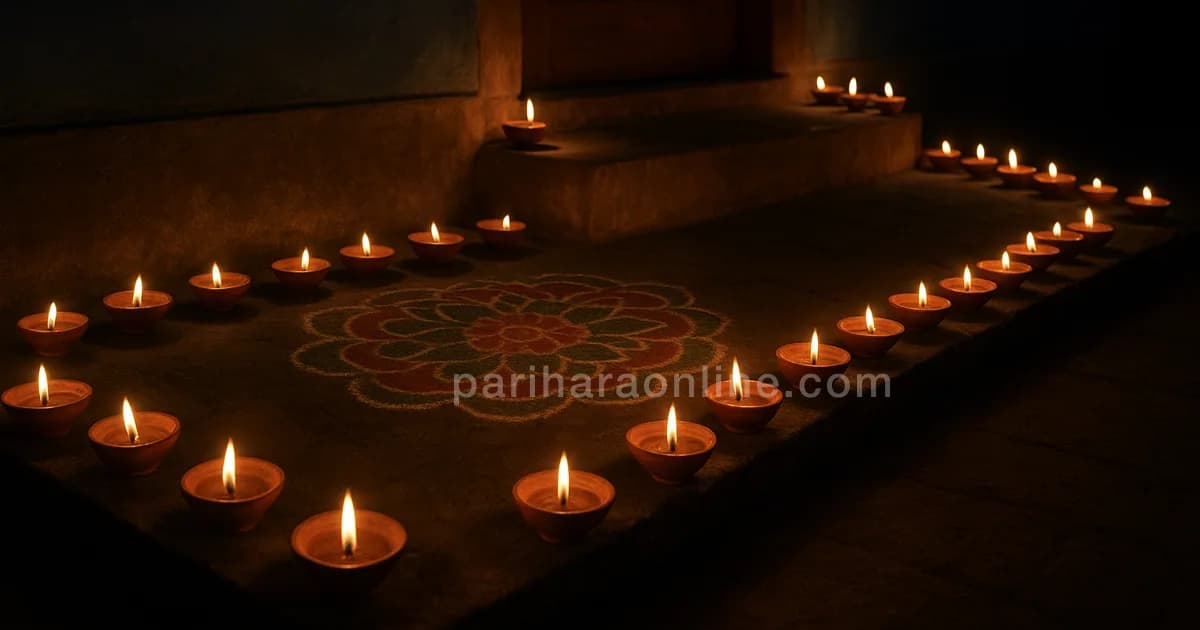
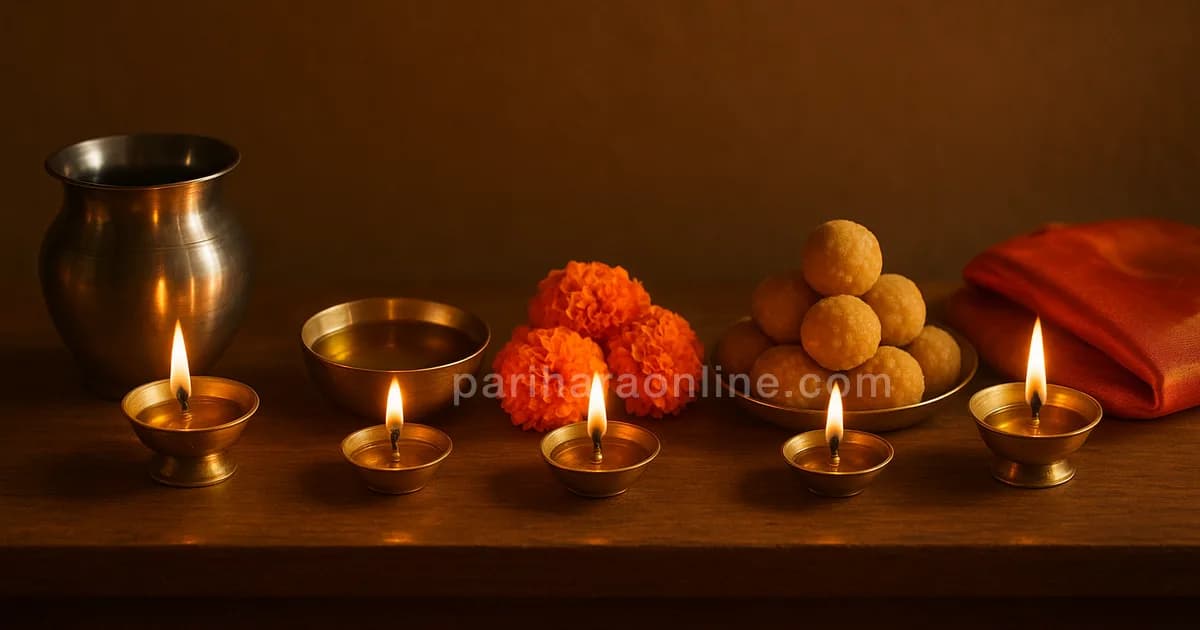
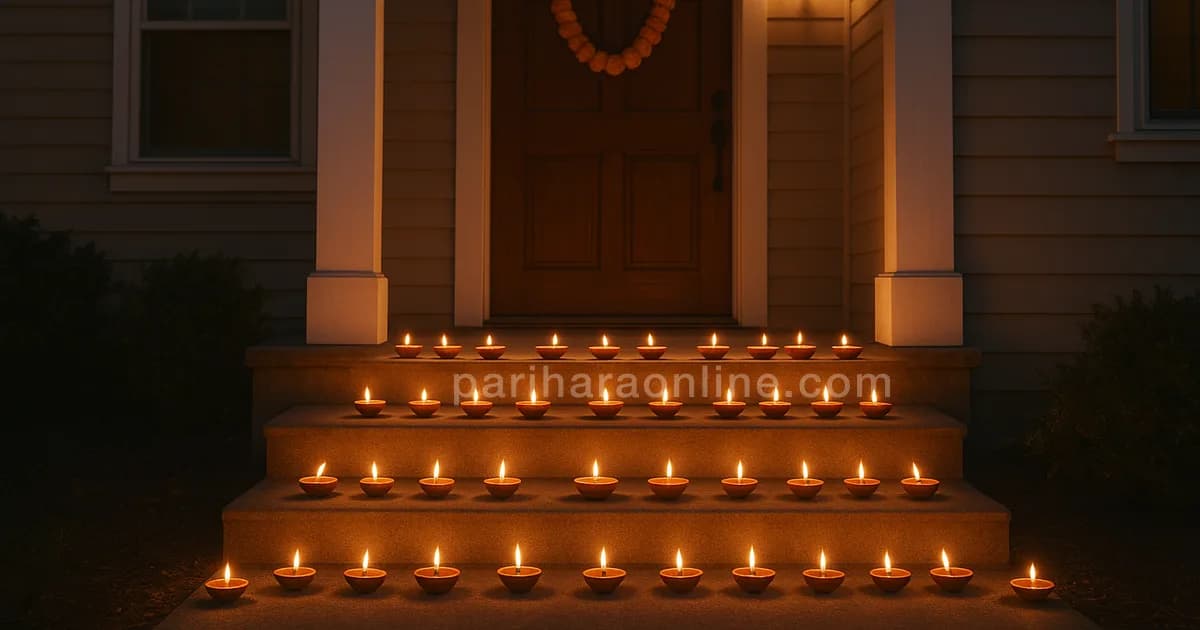
Festivals bring out the ambitious versions. During Deepavali, rangolis grow large and colourful, with lamps set around their edges; the five days of Diwali each offer a reason to redraw. At harvest, the Pongal kolam often shows a pot boiling over, sugarcane on either side. And in the cold month of Margazhi, Tamil streets compete with enormous kolams before sunrise, a practice tied to the devotion of the season described in what the month of Margazhi means.
If you want the wider story of why the whole festival of lights exists, start with why Diwali is celebrated. The kolam is one small, daily version of the same lamp.
Try a five-dot kolam for a week
You do not need a courtyard. Lay five dots in a cross on your front step, or on a tray just inside an apartment door if the step is shared or snowbound. Join them with a simple looping line. Use rice flour if you can, so something small gets fed; chalk works on a porch. Families abroad often keep a small rangoli going through the festival, and there are ideas for that in celebrating Diwali in the USA.
Do it every morning for a week. Do not worry if it is crooked. Notice instead what it does to the way you leave the house. You may find you step out a little slower, having already given something away.
Questions people ask
What is the spiritual meaning of rangoli?
Rangoli is a welcome drawn at the entrance of a home. Tradition says it invites Lakshmi, the goddess of prosperity, and keeps the threshold auspicious. Many families also see it as a way of beginning the day with attention and beauty, offering something lovely to anyone who crosses the doorway, whether guest, neighbour or passer-by.
Why is kolam drawn with rice flour instead of chalk?
Rice flour kolam feeds ants, sparrows and other small creatures that nibble at the lines through the day. In Tamil homes this is understood as a quiet form of charity, a way of sharing food before eating yourself. Chalk and powder colours are used for festival designs, but the everyday dawn kolam is traditionally rice.
Is it okay to draw rangoli inside an apartment?
Yes. Many families living in apartments or rented homes draw a small rangoli on a wooden board, a tray or a mat by the door or the puja corner. Removable stickers and chalk work too. The intention of welcome and order matters more than the surface, and a small design done with care is fully in keeping with tradition.
What is the difference between kolam and rangoli?
Kolam is the South Indian form, usually white rice flour drawn in lines around a grid of dots, often made daily at dawn. Rangoli is the broader North and West Indian term, typically colourful and freehand, and most common at festivals like Diwali. Both share the same idea: a threshold drawing that welcomes and blesses.
Enjoying this?
To get more Kolam posts like this, subscribe for free.
Written by
Reads the old stories for what they still mean
Hariharan writes about the myths, symbols and festival stories that most of us grew up hearing but were rarely asked to think about. He tells the story first, then asks what it is really about, and leaves the conclusion to you.