Why Is Diwali Celebrated? Four Stories, One Light
Why is Diwali celebrated? Rama's return, Krishna and Narakasura, Lakshmi's arrival and Mahavira's liberation: four stories and the one light they share.
· 4 min read
In short
Diwali is celebrated for several reasons: Rama's homecoming to Ayodhya, Krishna's victory over Narakasura, Lakshmi's arrival from the cosmic ocean, and Mahavira's liberation in the Jain tradition.
It falls on the new-moon night of Karthika (Ashwin in some calendars), usually late October or November, so its lamps light the darkest night of the month.
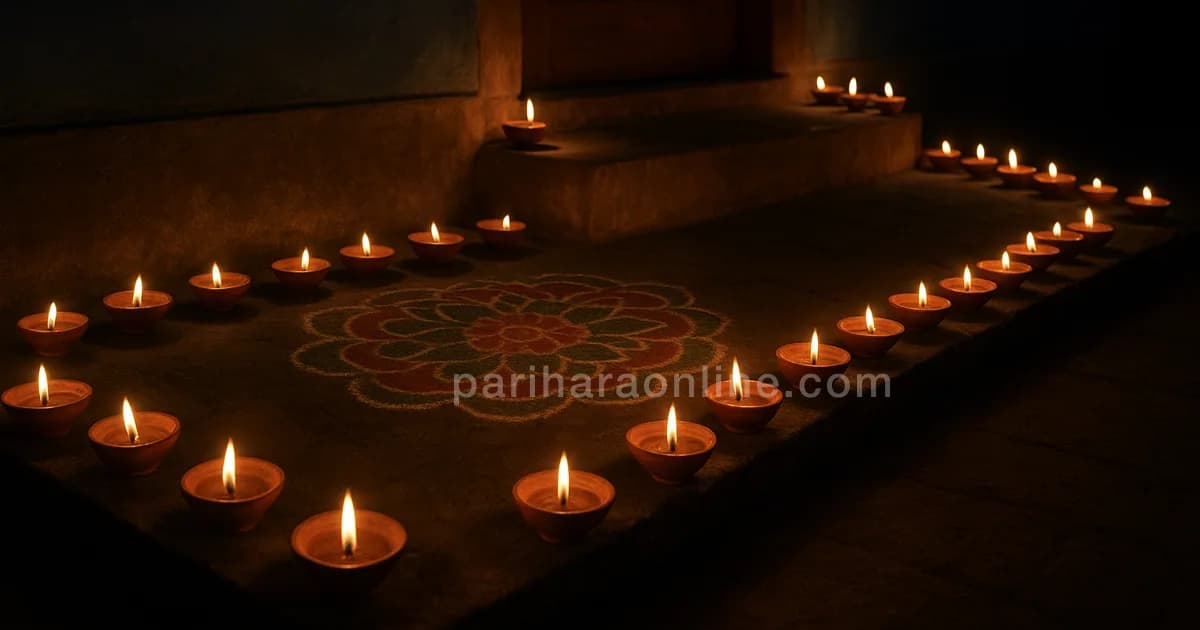
Ask four Indian families why Diwali is celebrated and you may hear four different stories: a prince coming home, a demon defeated, a goddess rising from the sea, a teacher's final liberation. Every one of them ends with a lamp. Diwali, or Deepavali, means "a row of lamps", and it falls on the darkest night of the lunar month, the new moon of Karthika, usually in late October or November. The stories differ by region. The flame is the same everywhere, and that is the real answer.
Why is Diwali celebrated in the north?
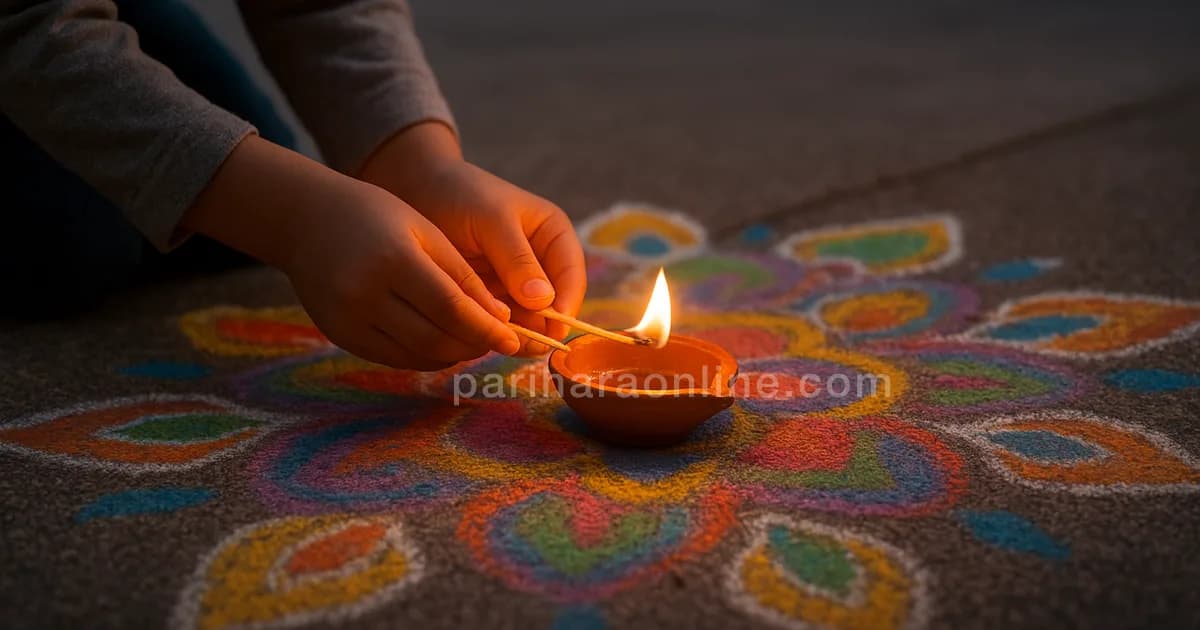
In most of north India, Diwali is Rama's homecoming. The Ramayana tells of the prince who spent fourteen years in exile in the forest, lost his wife Sita to the demon king Ravana, crossed the sea, fought a war and finally won her back. When he returned to Ayodhya with Sita and his brother Lakshmana, the people of the city did not know exactly when he would arrive. So they lit lamps, rows and rows of them, along every roof and path, so that the way home would be bright whenever he came.
It is a lovely detail. Nobody lights lamps for someone who is already in the room. The lamps are for the one still on the road. Families with children away, in another city or another country, understand this part of the story without being told.
Deepavali in the south and the other stories
In Tamil Nadu, Karnataka and much of the south, Deepavali morning belongs to a different hero. The Bhagavata Purana tells of Narakasura, a demon who had imprisoned thousands of women and stolen the earrings of the mother of the gods. Krishna rode out against him with his wife Satyabhama beside him on the chariot, and in many southern tellings it is Satyabhama herself who strikes the final blow. As he died, Narakasura asked that the day be remembered with lights. That is why the south celebrates before dawn, with an oil bath and crackers; the ritual is described in Naraka Chaturdashi and the Deepavali oil bath.
Then there is Lakshmi. The Puranas describe the gods and demons churning the ocean of milk for the nectar of immortality, and among the treasures that rose from the waves was Lakshmi, goddess of wealth and wellbeing, seated on a lotus. The new-moon night of Diwali is when many families invite her in, and there is a gentle guide to Lakshmi puja at home when you live abroad.
Diwali is not only Hindu. For Jains it marks the night Mahavira attained final liberation. For Sikhs it is Bandi Chhor Divas, remembering Guru Hargobind's release from imprisonment along with other captive kings. Different traditions, same night, same lamps.
What do all the stories share?
Put the stories side by side and a pattern appears. Rama's story is about return. Krishna's is about rescue. Lakshmi's is about abundance. Mahavira's and the Guru's are about release. Each is a story of something that was lost, trapped or far away coming back into the light.
And all of them happen on the new moon, when there is no moonlight at all. The tradition could have chosen the full moon for its biggest festival of light. It chose the opposite. The story says a hero returned. The story is really about what we do in the darkest part of the year, when the evenings close in early and the mind turns to what it lacks. We do not argue with the dark. We light a very small flame, then another, then another, until the house can be found. If you want to know why that small act carries so much weight, read why Hindus light lamps.
The festival itself stretches over five days of Diwali, from Dhanteras to Bhai Dooj, each with its own small practice.
Tell one story, light one lamp
This season, pick one Diwali story, the one your family grew up with or one you never heard as a child, and tell it to the people you live with. Children, flatmates, a partner who grew up somewhere else. It does not need to be long or accurate to the last detail. Explaining Diwali to kids has a few ways to begin.
Then light the first lamp together while you tell it. That is how the stories have always travelled: from one person holding a flame to the next.
Questions people ask
What is the main story behind Diwali?
In north India the best-known story is Rama returning to Ayodhya after fourteen years of exile and defeating Ravana; the city lit rows of lamps to welcome him. In Tamil Nadu and much of the south, Deepavali honours Krishna's victory over the demon Narakasura. Lakshmi Puja on the same night celebrates the goddess of abundance. All are traditional.
Why is Diwali called the festival of lights?
The name Deepavali means a row of lamps. It falls on the new moon, the darkest night of the lunar month, and homes are lit with clay oil lamps, candles and electric lights. The lamp is a symbol of knowledge pushing back ignorance, and of welcoming Lakshmi and returning heroes home. The light is the one element every Diwali story shares.
How can I explain the Diwali story to kids simply?
Try this: a good prince named Rama was sent away from home for many years. He rescued his wife Sita from a demon king and finally came home. The whole city was so happy they lit lamps on every doorstep so he could find his way in the dark. That is why we light lamps: to welcome goodness home.
Enjoying this?
To get more Diwali posts like this, subscribe for free.
Written by
Reads the old stories for what they still mean
Hariharan writes about the myths, symbols and festival stories that most of us grew up hearing but were rarely asked to think about. He tells the story first, then asks what it is really about, and leaves the conclusion to you.