Navratri Golu at Home in a Small Apartment
Navratri Golu at home in a small apartment: how many steps you need, which dolls to start with, a safe setup with kids, and evening visitors.
· 4 min read
In short
Navratri Golu at home needs only an odd number of steps, three works in a small apartment, arranged with deities at the top and everyday life below.
Each evening, light a lamp before the Golu, sing or chant briefly, and offer sundal to visitors; the ritual is the gathering.
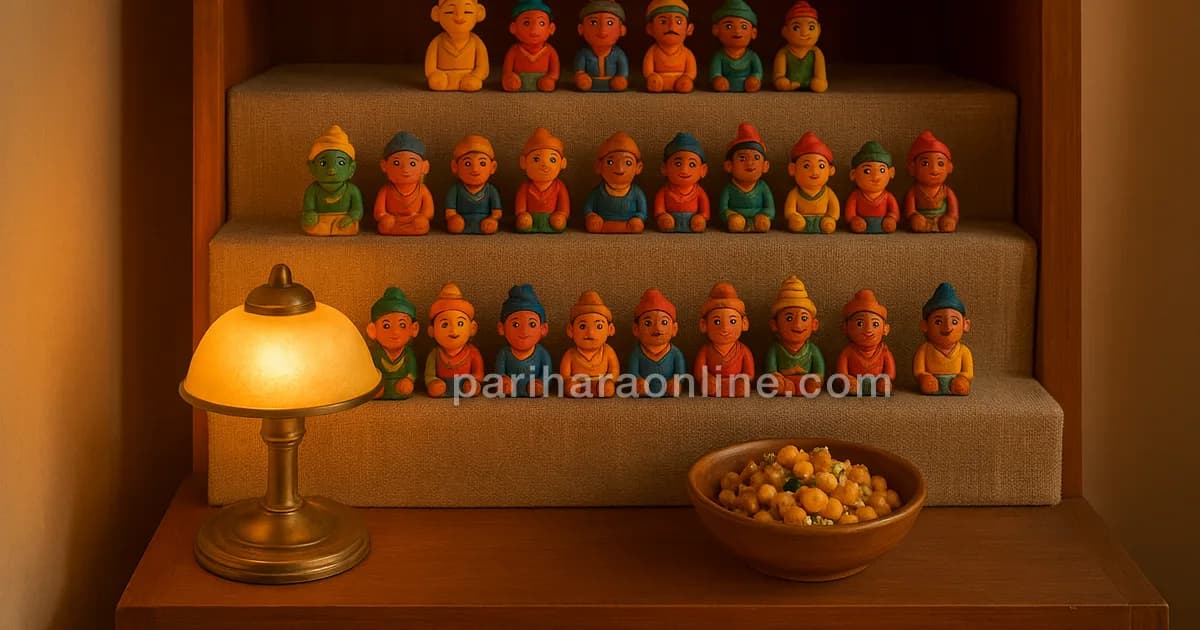
Golu is a staircase of dolls, and it works just as well on three bookshelf steps in a one-bedroom apartment as on nine in a big house. Setting up Navratri Golu at home needs only an odd number of steps, a cloth to cover them, and dolls arranged with the deities at the top and everyday life below. Each evening of Navratri, you light a lamp before it, sing or chant briefly, and offer sundal, a simple dish of spiced legumes, to whoever drops by. The dolls are the display. The gathering is the ritual.
Navratri golu at home: how many steps?
Traditionally, an odd number: three, five, seven or nine. Nine is common in large homes because it echoes the nine nights, but three is entirely in the spirit of the thing. The tradition asks for order, not size.
In a small apartment, look at what you already have:
- A bookshelf. Clear three shelves, top to bottom, and you have a Golu. It is already stable.
- Sturdy boxes. Stack three cardboard or wooden boxes of decreasing height against a wall. Moving boxes, taped shut, work well.
- A folding stand. Indian stores and online shops sell collapsible Golu steps that pack flat for the rest of the year.
Cover the steps with a clean cloth, a sari or a white bedsheet. Tuck the edges in firmly. If there are toddlers or a cat in the home, put the lightest and most breakable dolls on the higher steps and anchor the stand to the wall. Stability matters more than height.
If you already have a permanent altar, Golu can sit beside it; see making a small puja corner in an apartment for how to use a tight space well.
Which dolls go where?
Bommai means doll in Tamil, and Golu means a royal court: Bommai Golu is the Goddess holding court with all of creation. The arrangement follows that idea, moving from the divine at the top to the everyday at the bottom.
- Top step: the deities, often Durga, Lakshmi and Saraswati, with a kalash, a small pot of water topped with a coconut and leaves, representing the Goddess.
- Middle steps: avatars, saints and scenes from festivals, weddings, temple processions.
- Lowest step: people at work, shops and village scenes, animals and birds. Many families place the marapachi dolls, a wooden bride and groom pair, somewhere prominent; they are often handed down.
Do not worry about having a doll for every category. Start with three things: one deity, one pair of people, one animal. That is a complete Golu. The meaning behind the Goddess herself, and why the gods gave up their powers to create her, is told in why Navratri lasts nine nights.
What do you do with Golu each evening?
This is the part that makes it a practice rather than a decoration.
At dusk, light a lamp at the base of the steps. Sit in front of it for a minute before anyone arrives. Look at the whole display, top to bottom, slowly. Notice that the gods and the vegetable seller are on the same staircase. That is the teaching, and it lands better through the eyes than through any explanation.
Then sing a short song or chant a name of the Goddess. It can be one line. Offer the sundal, chickpeas or lentils tempered with mustard seeds and coconut, which is easy to make in a small kitchen, and then share it. Traditionally, women and children visit each other's Golus in the evenings, sing a song, and leave with sundal and a small gift, often turmeric and kumkum, the red and yellow powders offered to the Goddess. In the US, this becomes a weekend round of visits, which is covered in how to celebrate Navratri in the USA.
Towards the end of the nine nights, Ayudha Pooja brings tools and books to the altar; the reason is told in what Ayudha Pooja means. Some households place a few of those books at the foot of the Golu that evening.
Try this: one new doll a year
Every Navratri, add one new doll. Only one. Choose it with some thought, and write down in a small notebook why you chose it: a clay Ganesha bought at a temple in Pittsburgh, a cow because your daughter asked for one, a doll your mother mailed from Chennai.
After a decade, your Golu will be a record of your family, step by step. Children in particular love this; the notebook becomes the story they tell visitors, and giving children a festival task of their own starts right there. Start with three steps, and let the staircase grow with you.
Questions people ask
How many steps should a Golu have?
Traditionally Golu has an odd number of steps, most often three, five, seven or nine. Nine is common in larger homes, echoing the nine nights. In a small apartment, three steps made from a bookshelf, sturdy boxes or a folding stand covered with cloth is entirely traditional in spirit. Stability matters more than height.
How do you arrange Golu dolls step by step?
The usual order moves from the divine to the everyday. The top step holds deities, often with a kalash; the next holds avatars and saints; middle steps hold festivals, weddings and village scenes; the lowest hold animals, birds and daily life. The arrangement mirrors the idea that all life, high and ordinary, is sacred.
What is the meaning of Bommai Golu?
Bommai means doll and Golu means royal court in Tamil. The display represents the Goddess holding court with all of creation. Many families link it to the Devi Mahatmyam, where the gods gave their powers to create Durga. It is also a social ritual: families visit each other's Golu, sing and exchange sundal and small gifts.
Enjoying this?
To get more Navratri posts like this, subscribe for free.
Written by
Writes about practice: attention, breath, the body, the lamp
Archana writes about ritual as something you do rather than something you believe: the lamp, the breath, the fast, the few quiet minutes before the day begins. Her pieces usually end with a small practice to try for a week and notice what changes.