What Is a Muhurtham? Choosing an Auspicious Time
What is a muhurtham? How an auspicious time is chosen for weddings, housewarmings and new starts in Jyotish, and what the practice says about beginnings.
· 4 min read
In short
A muhurtham is an auspicious time chosen from the Hindu almanac for starting something important, such as a wedding, housewarming or new business.
It is worked out from the lunar day, birth star, weekday and the charts of the people involved.
Tradition treats a good muhurtham as support for a beginning, not a guarantee of its outcome.
Families in South India will wake at four in the morning, dress in silk in the dark and drive to a wedding hall so that a thali, the sacred marriage thread, is tied at exactly 6:12. Ask what is muhurtham, and they will say it is the auspicious time, chosen from the stars, when the beginning will go well. It sounds like a question about the stars. It is really a question about how seriously we are willing to take a beginning, and what we are telling ourselves when we set an alarm for four.
What is muhurtham, and how long is it?
In the old reckoning, a day and night were divided into thirty muhurtas of about forty-eight minutes each, fifteen for daylight and fifteen for night. Each had a name and a character. Muhurat meaning, in the strict sense, is one of these units.
In wider use, the word now means any auspicious window chosen for a beginning: a wedding, a housewarming, a naming ceremony, the first day of a business, a child's first letters. When a family says "the muhurtham is at nine", they mean a particular slice of the morning that an astrologer or priest has found favourable, often a window of an hour or two with a precise moment inside it. It is the positive counterpart to rahu kalam, which marks a window to avoid.
How is muhurtham calculated?
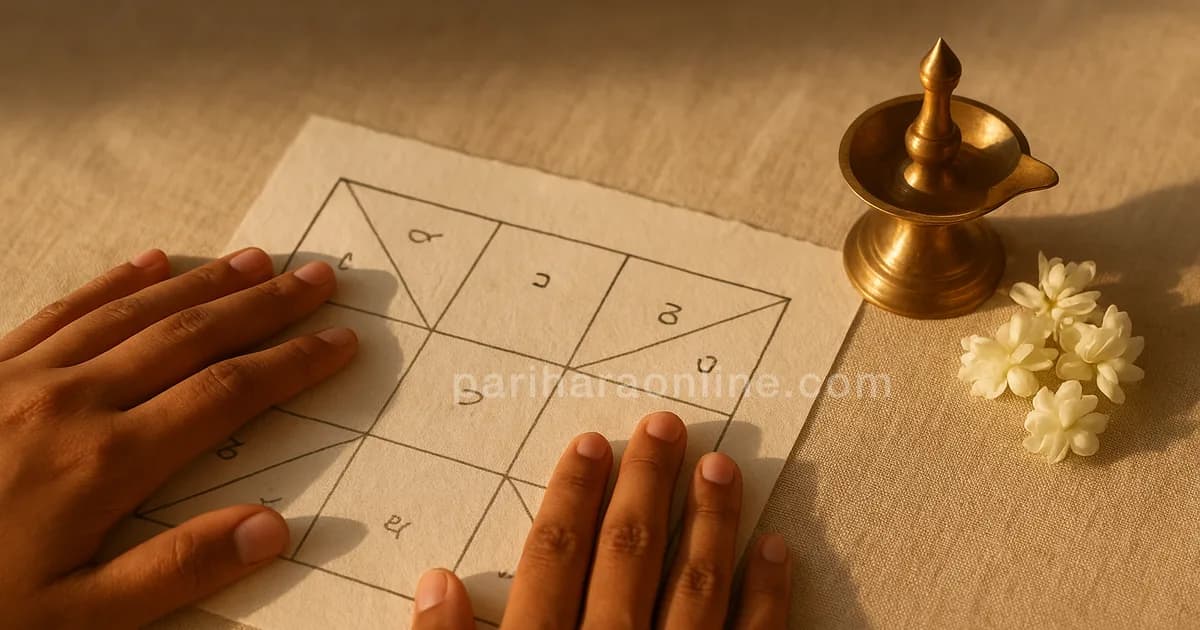
How is muhurtham calculated, then? The priest begins with the panchangam, the traditional almanac, whose name means "five limbs". The five are tithi, the lunar day; vara, the weekday; nakshatra, the star the Moon is passing through; yoga, a particular angle between Sun and Moon; and karana, half of a tithi. Each has favourable and unfavourable combinations for particular events.
Then the people come into it. For an auspicious time for a wedding, the birth charts of both bride and groom are consulted, along with the ascendant rising at the proposed moment, the positions of Jupiter and Venus, and whether the season is considered open for weddings at all. Some months are traditionally avoided. Stack all those filters together and the options narrow sharply, which is why a priest may offer only a handful of dates in an entire season and why wedding halls book out on those days. On the day itself, the whole ceremony is built around that moment, usually the tying of the thali; Hindu wedding rituals explained for guests walks through what happens around it. If you want to know how this system differs from the astrology in a newspaper column, Vedic vs Western astrology explains the difference.
Does the muhurtham decide the outcome?
Here is a story worth knowing. In the Valmiki Ramayana, the sage Vasishtha fixes the most auspicious moment for Rama's coronation. The city is decorated. The day is perfect. And by morning, Rama is not crowned at all but sent into exile for fourteen years. The finest muhurtham in literature did not prevent the story from happening.
Tradition knows this. It treats timing as support, not guarantee. A good muhurtham is like a fair wind: it helps the boat, but it does not sail it. The tradition also offers a fallback for ordinary life. Abhijit muhurtham, the window around local midday, is widely considered auspicious on most days for most beginnings, so nobody need be stranded without a good hour.
Is any of this literally true? People disagree, and is astrology real takes that question honestly. But notice what the practice does regardless. It makes a family stop and ask when, rather than just starting. It makes everyone arrive on time and in the same place. It turns a beginning into an occasion. Much of what is fearful in astrology, the dread described in Sade Sati explained, comes from forgetting that its oldest purpose was to help people act thoughtfully, not to frighten them into stillness.
Choosing your next beginning with care
For your next big start, a new home, a new job, a first day, ask yourself one question before you consult anyone: what time would feel considered and calm? Not rushed, not squeezed between errands, not at the end of a draining day.
You may then want an astrologer to find a traditional muhurtham, and that is a fine thing to do. For a housewarming, it sits naturally inside the Griha Pravesh puja steps. Or you may choose the midday Abhijit window and a quiet lamp. Either way, you will have done what the four a.m. families are really doing. You will have paused before beginning.
Questions people ask
What does muhurtham mean?
Strictly, a muhurtham is a unit of time of about forty-eight minutes, one of thirty in a day. In common use it means an auspicious time chosen for an important event, such as a wedding, griha pravesh, naming ceremony or business launch. The chosen moment is meant to align the beginning with favourable conditions described in Jyotish.
How is a muhurtham calculated for a wedding?
An astrologer studies the panchangam for suitable tithis, nakshatras and weekdays, rules out inauspicious periods and months, then checks the bride's and groom's birth charts for compatibility with the chosen day. The final muhurtham is a specific window, often early morning. Because many conditions must align, good wedding dates can cluster in certain months.
What is Abhijit muhurtham?
Abhijit muhurtham is the period around local midday, roughly twenty-four minutes before and after the Sun reaches its highest point. Tradition considers it broadly auspicious for most beginnings, and it is often suggested when no other suitable time can be found. Many sources exclude Wednesday. A panchangam for your city will show the exact window.
Is it necessary to follow a muhurtham?
It is a tradition, not a requirement. Many families value it because choosing a time deliberately brings attention and blessing to a beginning. Others, especially abroad where dates depend on venues and leave, pick a practical day and offer prayers. Priests often say that a sincere prayer before starting matters as much as the clock.
Enjoying this?
To get more Muhurtham posts like this, subscribe for free.
Written by
Reads the old stories for what they still mean
Hariharan writes about the myths, symbols and festival stories that most of us grew up hearing but were rarely asked to think about. He tells the story first, then asks what it is really about, and leaves the conclusion to you.