Is Astrology Real? An Honest Look at Jyotish
Is astrology real? An honest look at Jyotish: what it claims, what science says, and why many people still find a birth chart useful as a mirror, not a verdict.
· 4 min read

In short
Controlled studies have not shown astrology predicting events reliably, and honest practitioners of Jyotish rarely claim certainty.
Many people use a birth chart as a mirror for reflection and timing, not as a verdict on their life.
You can respect the tradition and stay sceptical at the same time; Hinduism has always made room for both.
A friend once asked me, over coffee and half teasing, whether I really believe in my chart. Is astrology real? The honest answer is that it depends on what you think astrology is for. If you mean "can a chart predict what will happen to me next spring", the evidence says no. If you mean "can a chart give me a structured way to pause and think about my life", many thoughtful people say yes. I had just mentioned that my mother had sent my son's horoscope to a family astrologer in Madurai. I gave my friend a muddled answer then. This is the better one.
Is astrology real, or is that the wrong question?
When people ask whether astrology is real, they usually mean whether it predicts. On that, the record is fairly clear. Controlled studies, where astrologers were asked to match charts to personalities or life events, have not shown results better than chance. If you are asking whether astrology is scientific in the way chemistry is, it is not, and it is kinder to say so plainly than to dress it up.
But prediction is only one thing a chart can be used for. My friend reads her horoscope app the way some people read a fortune cookie. My mother reads a chart the way she reads a letter from an elder: carefully, looking for what is being asked of her. Those are different activities, and the question "does Vedic astrology work" means something different for each.
What Jyotish actually claims
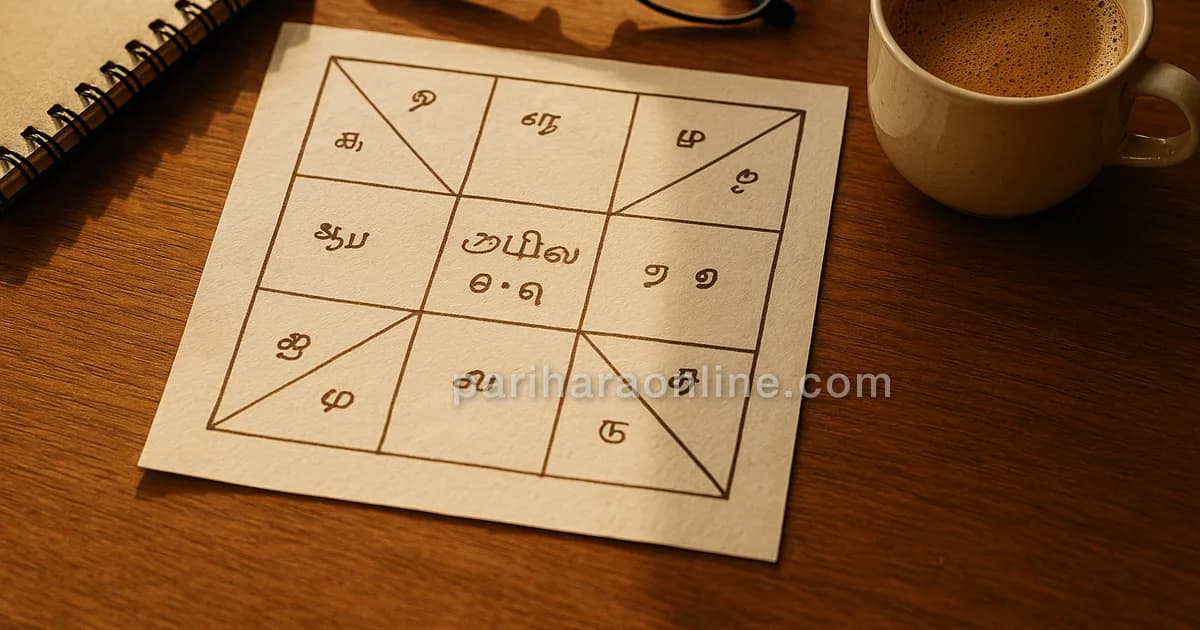
Jyotish, the Indian system of astrology whose name means "the science of light", grew up alongside the calendar. Its first job was timing: when to sow, when to hold a festival, when to begin something. The personal chart, the kundli, came to be read as a map of karma, the tendencies a person carries in from past action.
The more careful astrologers I have met are surprisingly humble about it. They talk about tendencies, seasons and "what is favoured", not about fixed fate. Several have said to me, without my asking, that effort can change what the chart shows. The tradition has its own way of keeping itself honest. Tiruvalluvar wrote in the Tirukkural that those who strive without faltering will see even fate turned back. That verse sits comfortably next to a horoscope in many Tamil homes, and nobody finds it a contradiction. If you want the longer version of that argument, astrology and free will walks through the old stories.
Why do people believe in astrology anyway?
I asked my mother once why she still consults one, given that she is a retired science teacher. She thought about it and said, "Because it makes me stop." Before a wedding, a house move, a surgery, the chart is a reason to slow down and talk to someone older about what might go wrong and what to be careful of.
That is closer to how many people use it than any claim about planets. A chart gives a vocabulary for hard seasons. When someone says they are "in sade sati", the seven-and-a-half-year period linked with Saturn, what they often mean is "this is a heavy stretch and I need patience". You can read a calm explanation of Shani and sade sati without accepting every forecast attached to it. The language lets families talk about difficulty without blaming anyone.
There is also the simple fact that astrology is a shared language with parents and grandparents. For those of us who live far from them, it is sometimes one of the few threads we still hold in common.
Holding both at once
You can respect the tradition and stay sceptical at the same time. Hinduism has always made room for both; some of its oldest schools argued against astrology and ritual and stayed inside the fold. What matters more is how a chart changes your conduct. If it makes you anxious and passive, it is not serving you. If it makes you more careful and more kind, it might be. For the idea underneath it all, karma explained without the guilt is a good place to start.
If you are curious rather than convinced, begin with the basics. Vedic and Western astrology use different zodiacs, which is why your sign may change between them, and reading your birth chart without fear shows how to approach it as a map rather than a verdict.
One small thing to carry into this month: if you have a chart, read it as a list of questions, not answers. Pick one question it raises and let it shape one decision. Notice what changes, not in the stars, but in how you act.
Questions people ask
Is astrology scientifically proven?
No. Controlled studies have not shown that astrological charts predict personality or events better than chance. Many people who value Jyotish accept this and treat it as a traditional framework for reflection and timing rather than a laboratory science. You can find meaning in it without claiming it is proven, and you can decline it without disrespecting those who use it.
Does Vedic astrology work better than Western astrology?
They use different zodiacs and different emphases, so they often give different placements for the same person. Neither has been shown scientifically to predict outcomes. Devotees who prefer Vedic astrology usually value its link to karma, remedies and temple practice, and its detailed system of planetary periods, rather than claiming it is more accurate in a measurable sense.
Why do so many smart people still believe in astrology?
Often it is less about belief and more about use. A chart gives a vocabulary for difficult seasons, a nudge to pause before big decisions, and a shared language with parents and grandparents. For many, consulting an astrologer is closer to asking a wise elder for perspective than to trusting a forecast.
Can I be sceptical of astrology and still be a good Hindu?
Yes. Hindu tradition includes schools that questioned astrology, rituals and even gods, and they remained within the fold. Devotion, ethical living and self-inquiry matter far more than whether you consult a horoscope. Many devout families simply treat Jyotish as optional guidance and focus their practice on prayer, service and daily discipline.
Enjoying this?
To get more Astrology posts like this, subscribe for free.
Written by
The Sunday column: festivals and rituals meeting ordinary weeks
Manikandan writes the Sunday column, where festivals and rituals meet commutes, hospital corridors and video calls with parents far away. Each piece closes with one small thing to carry into the week ahead.