Reading Your Birth Chart Without Fear
How to read a birth chart without fear: a calm, practical way to look at houses, planets and dasha periods as questions to work with, not verdicts to dread.
· 4 min read
In short
Start with your ascendant and moon sign, then the twelve houses; skip the frightening labels until you understand the basics.
In Jyotish, doshas and difficult periods describe tendencies and seasons, not fixed punishments.
A chart is most useful when it changes what you pay attention to and how you act this week.
Here is how to read a birth chart without frightening yourself: breathe first, then read it in layers. Ascendant, moon, the twelve houses, and only then the planets. Most people open their chart the way they open a medical report, bracing for the worst line, scanning for the word that will ruin the week. Do the opposite. Sit down, put your feet flat on the floor, take three slow breaths, and look at the chart the way you would look at a map of a city you are about to visit.
How to read a birth chart, one layer at a time
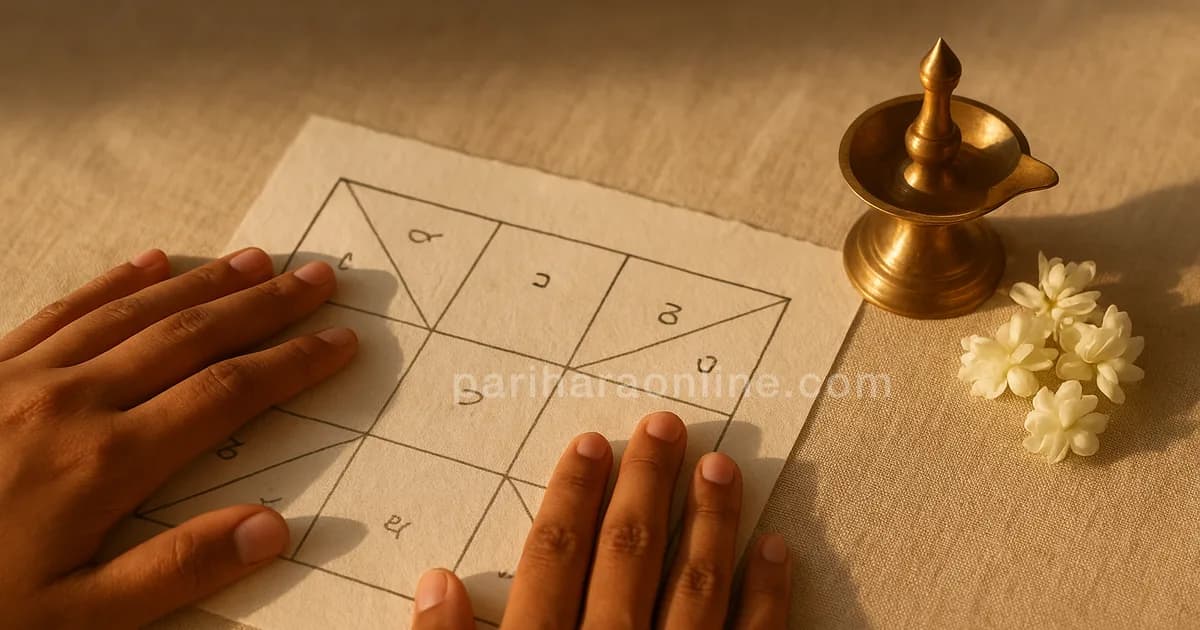
A Vedic birth chart, the kundli, is a snapshot of the sky at the moment and place you were born. Start with the lagna, the ascendant, which is the sign rising on the eastern horizon at your birth. It marks the first house and sets the orientation of everything else.
Next, find your moon sign, called rasi, and your nakshatra, the lunar mansion the moon was in. In Jyotish, the moon is linked with the mind and emotions, so many astrologers treat it as more personal than the sun.
Then look at the houses. What are houses in a kundli? They are twelve slices of life: self, family and speech, courage, home and mother, children and creativity, health and daily work, partnership, change, fortune and teachers, career, gains, and release. Notice which signs fall where. Do not interpret yet. Just learn the layout.
Only after that, look at the planets and where they sit. This order matters for a simple reason. The mind grabs the first dramatic thing it sees and builds a story around it. If you learn the whole shape first, no single placement can hijack you.
What do the scary words actually mean?
Charts come with vocabulary that sounds like a diagnosis. Dosha, which literally means a fault or imbalance. Malefic, the label for planets like Saturn and Mars that are traditionally associated with difficulty. Sade sati, the seven-and-a-half-year stretch when Saturn moves around your moon sign.
Here is a more useful way to hold them. In the tradition, these describe tendencies and seasons, not punishments. A Mars placement read as mangal dosha describes intensity and drive that need handling in a marriage; it does not describe a doomed marriage. Sade sati is described as a period of pressure and discipline, and people who go through it often speak of it as the season they grew up. The practical side of that season is covered in sade sati remedies that make sense.
Notice what happens in your body when you read one of these words. The shoulders lift, the breath goes shallow. That reaction, a mild form of birth chart anxiety, is information about you, not about the planets. Let it pass before you read on.
Using the chart as a practice
A chart is most useful when it changes what you pay attention to. Try this. Pick one house your chart seems to emphasise, perhaps the sixth, daily work and health, or the fourth, home. Then choose three things connected to it: one area of life to watch, one habit to strengthen, one prayer or quiet minute to offer each day.
If the chart points to health, maybe the habit is sleeping at the same time for a month. If it points to relationships, maybe it is putting the phone away at dinner. The planets will do whatever they do. Your attention is the part you control, and the tradition itself insists on this; astrology and free will explains how Hindu thought separates the karma already in motion from the karma you are making now.
When you do want an interpretation, go to a calm astrologer rather than a search engine at midnight. A good one reads combinations, not isolated lines, and will not sell you fear. If you are still unsure whether any of this is for you, an honest look at whether astrology is real may help you decide.
Try this for a week
For seven evenings, write one line in a notebook about the area of life your chart points to. Not what the planets did. What you did. "Slept at eleven." "Called my sister." "Snapped at a colleague, apologised." At the end of the week, read the seven lines together. You will learn more about yourself from them than from any forecast, and you will have used the chart the way it was always meant to be used: as a reason to pay attention.
Questions people ask
Where do I start when reading my Vedic birth chart?
Begin with the ascendant, the sign rising in the east at your birth, which sets the first house. Then note your moon sign and nakshatra. Next, see which signs fall in each of the twelve houses. Only after that look at where individual planets sit. Building up slowly keeps you from fixating on one alarming phrase.
What are houses in a kundli?
A kundli divides life into twelve houses, each linked to an area such as self, family, learning, home, children, work, partnership or spiritual growth. The planets and signs occupying a house colour how that area is traditionally read. They describe themes to reflect on, not guaranteed events, and good astrologers read them in combination.
Why does looking at my birth chart make me anxious?
Charts are full of dramatic words like malefic and dosha, and online readings often exaggerate them. Anxiety usually comes from reading one feature in isolation. It helps to remember that Jyotish itself sees the chart as a map of tendencies shaped by effort, and to consult a calm astrologer rather than a search engine at night.
Enjoying this?
To get more Astrology posts like this, subscribe for free.
Written by
Writes about practice: attention, breath, the body, the lamp
Archana writes about ritual as something you do rather than something you believe: the lamp, the breath, the fast, the few quiet minutes before the day begins. Her pieces usually end with a small practice to try for a week and notice what changes.