Soorasamharam Story: What Murugan's Victory Means
Soorasamharam story and meaning: how Murugan fought Surapadman in the Skanda Purana, why the demon became a peacock and rooster, and what that ending teaches.
· 4 min read
In short
Soorasamharam re-enacts Murugan's victory over the asura Surapadman on the sixth day of Skanda Sashti, most famously at the seaside Tiruchendur temple.
In the Skanda Purana, the defeated demon becomes Murugan's peacock and rooster: the story transforms the ego rather than destroying it.
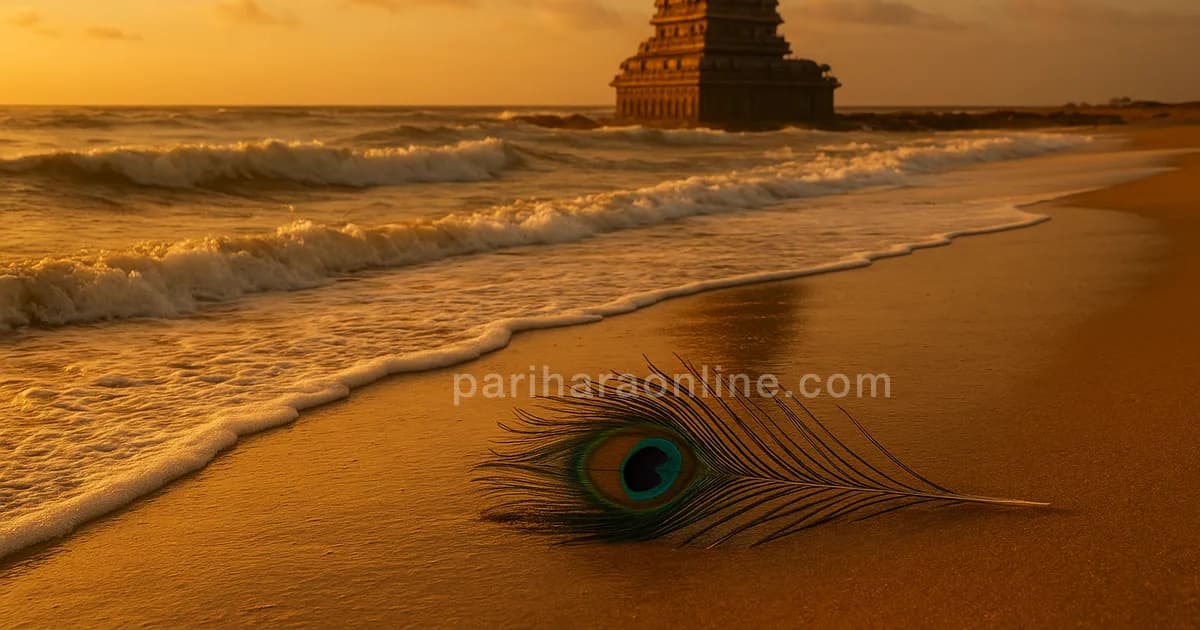
Most battle stories end with the villain dead. This one ends with the villain turned into the hero's vehicle and his flag. The Soorasamharam story, told in the Skanda Purana and its great Tamil retelling, the Kanda Puranam, describes Murugan defeating the demon Surapadman on the shore at Tiruchendur on the sixth day of a long battle. At the last moment, the demon is not destroyed. He is split in two, and the two halves become the peacock Murugan rides and the rooster on his banner. That ending is the whole point.
The Soorasamharam story in the Skanda Purana
Surapadman was an asura, a demon, who had performed long austerities and won an extraordinary boon from Shiva: that he could be defeated only by a son of Shiva. At the time, Shiva was deep in meditation after the loss of his wife Sati and had no son. Surapadman, feeling safe, took over the three worlds and imprisoned the gods.
The gods begged Shiva to wake. From his third eye came six sparks of fire, too hot for anyone to hold. The fire and the wind carried them to the Saravana pond, where they became six babies on six lotuses, raised by the six Krittika maidens, the stars known as the Pleiades. Parvati later gathered them into one child with six faces and twelve arms. He is called Skanda, Kartikeya, Subrahmanya, and in Tamil, Murugan, the beautiful one.
Before the battle, Parvati gave him the vel, a spear with a broad, leaf-shaped blade, which became his weapon and his emblem. He led the army of the gods south to Tiruchendur, on the sea, and fought Surapadman's brothers and generals one by one. The battle lasted six days. That is why Tamil devotees keep the six-day fast described in the Skanda Sashti fasting guide, and why the sixth evening is the night of Soorasamharam.
Why does Surapadman become a peacock and a rooster?
On the last day, Surapadman used every trick he had. He changed shape again and again. Finally he became a vast mango tree standing in the middle of the sea, hiding in its roots.
Murugan threw the vel. It split the tree down the middle. And here the story turns. As the halves fell, Surapadman, facing the young god at last, surrendered. Murugan did not finish him. One half of the tree became a peacock, which became his vahana, the animal that carries him. The other half became a rooster, the seval, which he placed on his flag.
So the demon did not die. He was put to work. Every image of Murugan riding his peacock is also an image of Surapadman carrying the one who defeated him.
What is Soorasamharam really about?
On its face, a god defeats a demon. Underneath, this is a story about what to do with the part of yourself you have been fighting.
Surapadman is not simply evil. He is ambition, pride, restlessness, a huge appetite for more. Those forces cannot be switched off; they are part of being alive. The Soorasamharam story suggests they can be redirected. The same energy that once made the ego tyrannical becomes the vehicle that carries you towards something better. The peacock is proud and beautiful. It is still a peacock. It just goes where Murugan wants to go now.
The vel matters too. It is not a club. It is long and pointed, a weapon of precision. Many teachers read it as discernment, the sharp, focused attention that can split a problem down the middle and see what it is made of. The victory comes not from force but from clarity.
This is why Tamil temples re-enact the battle every year instead of simply remembering it. The demon keeps coming back, in new shapes, and so the vel has to be thrown again. The same idea shows up elsewhere: Ravana's heads keep growing back in the story behind Dussehra. Some traditions have a gentler image for the same threshold, like the northern gate opened in the story of Vaikunta Ekadashi.
Ask what it would look like carrying you
On the night of Soorasamharam, think of one habit you keep fighting: the temper, the scrolling, the need to win every argument. Instead of trying to kill it, ask a different question. What would it look like if that energy carried you instead? The temper might become a clear, firm no. The restlessness might become a morning walk.
If this story stays with you, the next chapter of Murugan's year is Thaipusam; the meaning of the kavadi takes the idea of carrying somewhere new.
Questions people ask
What is the story of Soorasamharam?
The Skanda Purana tells of Surapadman, an asura who won a boon of near invincibility and oppressed the gods. Murugan, born from sparks of Shiva's third eye, received the vel, a spear, from Parvati and fought him for six days. On the last day Surapadman became a mango tree; Murugan split it with the vel, and the halves became a peacock and a rooster.
Why is the peacock Murugan's vehicle?
According to the Soorasamharam story, one half of the defeated Surapadman became the peacock that Murugan rides, and the other became the rooster on his banner. Symbolically, the proud, restless ego is not destroyed but tamed and put to work. The peacock, beautiful and vain, now carries wisdom instead of fighting it.
Where is Soorasamharam celebrated?
Soorasamharam is celebrated in Murugan temples across Tamil Nadu and wherever Tamil communities live, including Malaysia, Singapore, Sri Lanka and the United States. The most famous re-enactment is on the beach at Tiruchendur, one of the six abodes of Murugan, where the battle is traditionally said to have taken place. It falls on Sashti tithi in Aippasi.
Enjoying this?
To get more Skanda Sashti posts like this, subscribe for free.
Written by
Reads the old stories for what they still mean
Hariharan writes about the myths, symbols and festival stories that most of us grew up hearing but were rarely asked to think about. He tells the story first, then asks what it is really about, and leaves the conclusion to you.