The Six Abodes of Murugan: Arupadai Veedu
Arupadai Veedu are the six abodes of Murugan in Tamil Nadu: the story behind each temple, from Palani to Tiruchendur, and what the six together mean.
· 4 min read

In short
Arupadai Veedu are the six sacred abodes of Murugan in Tamil Nadu: Thiruparankundram, Tiruchendur, Palani, Swamimalai, Thiruthani and Pazhamudircholai.
They are named in the ancient Tamil poem Tirumurugatruppadai by Nakkeerar.
Each temple holds a different episode of Murugan's story.
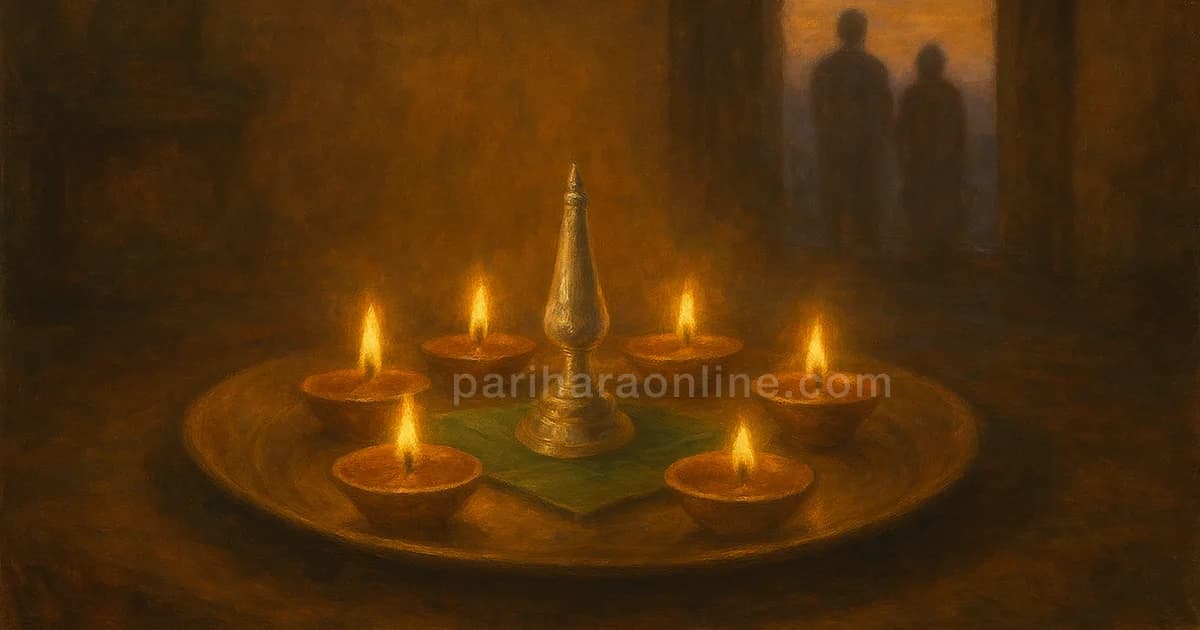
Arupadai Veedu, the six abodes of Murugan, are six temples in Tamil Nadu, each tied to a chapter of his story: Thiruparankundram, Tiruchendur, Palani, Swamimalai, Thiruthani and Pazhamudircholai. They come from a Tamil poem roughly two thousand years old that sends the pilgrim to six hills and shores. The story is a map of temples. The story is really a map of a life, from wanting to winning to letting go to understanding.
Arupadai Veedu: the six abodes named in Tirumurugatruppadai
The poem is the Tirumurugatruppadai, composed by the Sangam poet Nakkeerar. It belongs to a genre called aatruppadai, the guide poem, in which someone who has received a patron's generosity points the way for another seeker. Here the patron is Murugan, and the gift is grace. The later name "padai veedu" is usually read as the camps of his army, the places where the young general rests between campaigns.
The traditional order runs: Thiruparankundram near Madurai, Tiruchendur on the sea, Palani on its hill, Swamimalai near Kumbakonam, Thiruthani in the north, and Pazhamudircholai in the forest beyond Madurai. Pilgrims have walked this circuit for centuries, and many still do.
What story belongs to each abode?
Thiruparankundram is where Murugan marries Deivanai, daughter of Indra, after his victory. The first abode is a wedding. It is where life begins as most of us begin it: wanting, and getting.
Tiruchendur, on the shore, is the place of the battle itself, where he defeats the demon Surapadman; this is the story retold every year at Soorasamharam, the great destruction, at the end of the six days of Skanda Sashti fasting. The second abode is victory, with the sea behind it.
Palani is the renunciation. Murugan has just lost the race for the fruit of wisdom to his brother, the story told in why Ganesha is worshipped first, and, stung, he gives up his fine clothes and goes to stand alone on a hill with a staff. The story says a boy sulks. The story is really about the moment winning stops being enough.
Swamimalai reverses everything. Here the young Murugan asks Brahma the meaning of Om, finds him unable to explain it, and then, seated on Shiva's lap, teaches the meaning of the syllable to his own father. He is called Swaminatha, the teacher of the teacher. Wisdom, the story insists, does not respect age.
Thiruthani is where Murugan's anger cools after the war and where he marries Valli, the tribal girl he courted in disguise. It is the calm abode, the one after the battle.
Pazhamudircholai, the forest of ripe fruit, holds the gentlest tale. The poet Avvaiyar, old and famous, is resting under a tree when a cowherd boy asks whether she wants hot fruit or cold. Puzzled, she asks for hot. He shakes the branch, and the fruit falls into the dust. As she blows the dust off, he laughs: "Is it too hot, grandmother?" The boy is Murugan, and the great poet has just been taught by a child.
Why six? What the journey is said to mean
Murugan is Shanmukha, the six-faced one, born as six sparks of Shiva's fire and raised by six Krittika mothers before being gathered into one child; the same stars give their name to the festival of Karthigai Deepam. Six faces, six abodes. Many teachers read the circuit as a sequence of inner stages: desire fulfilled, conflict won, renunciation, knowledge, peace, and finally the playful simplicity of the forest, where even wisdom laughs at itself.
That is why the pilgrimage is often described as movement inward, not only across the map. The vows and hardships of pilgrims at Palani during Thai, described in the meaning of Thaipusam and the kavadi, are one way of making that inner journey visible.
If you cannot travel to all six
Most of us will not walk the full circuit. That is fine. Choose the abode whose story fits the season of your life. Newly married, or hoping to be? Thiruparankundram. In the middle of a fight? Tiruchendur. Tired of competing? Palani. Sit with that one story on a Sashti, the sixth lunar day, or on a Tuesday, Murugan's traditional day. One hill, well understood, is a pilgrimage too.
Questions people ask
What are the six abodes of Murugan?
The Arupadai Veedu are Thiruparankundram near Madurai, Tiruchendur on the sea coast, Palani in the western hills, Swamimalai near Kumbakonam, Thiruthani near Chennai and Pazhamudircholai near Madurai. Together they are the most sacred Murugan temples in Tamil tradition, and many devotees hope to visit all six in their lifetime.
What is the significance of Palani Murugan temple?
Palani is where Murugan, after losing a contest for a sacred fruit, left home and stood on the hill as a renunciate with a staff. He is worshipped there as Dandayudhapani. The temple is famous for its panchamritham prasadam and for pilgrims who climb the hill carrying kavadi, especially during Thaipusam.
In what order should the Arupadai Veedu be visited?
The traditional order follows the Tirumurugatruppadai: Thiruparankundram, Tiruchendur, Palani, Swamimalai, Thiruthani and Pazhamudircholai. Many pilgrims follow a route that suits travel instead, often starting near Madurai. There is no strict rule; devotion matters more than sequence, and visiting even one abode with care is valued.
Why does Murugan have six abodes?
Tradition links the six abodes to Murugan's six faces as Shanmukha and to six stages of the spiritual journey, from worldly life and struggle to renunciation and wisdom. Each temple marks a moment in his story, so visiting them in sequence is often read as walking through the growth of a seeker.
Enjoying this?
To get more Murugan posts like this, subscribe for free.
Written by
Reads the old stories for what they still mean
Hariharan writes about the myths, symbols and festival stories that most of us grew up hearing but were rarely asked to think about. He tells the story first, then asks what it is really about, and leaves the conclusion to you.