Uttara Ashadha (Uthiradam): The Star of Final Victory
Uttara Ashadha nakshatra, Uthiradam in Tamil: the Vishvedevas and Surya, the elephant's tusk, final victory, and the Keezha Poongudi temple for it.
· 4 min read
In short
Uttara Ashadha, Uthiradam in Tamil, is presided over by the Vishvedevas, the universal gods, with Surya as its ruling planet and an elephant's tusk as its symbol.
Tradition calls it the star of final victory: success that comes from patience and principle.
The Brahmapureeswarar temple at Keezha Poongudi is traditionally associated with Uttara Ashadha nakshatra.
My son, who is about eleven, finished a science project at midnight on a school night and announced, half asleep, that he had "won by not quitting." I told him there is a whole star for that. Uttara Ashadha nakshatra, Uthiradam in Tamil, is the twenty-first of the twenty-seven birth stars, and tradition calls it the star of final victory: not the win that comes in the first rush, but the one that is still standing when everyone else has gone home. He was unimpressed. He wanted toast. But I kept thinking about it on the train the next morning.
Uttara Ashadha nakshatra: all the gods, the Sun and a tusk
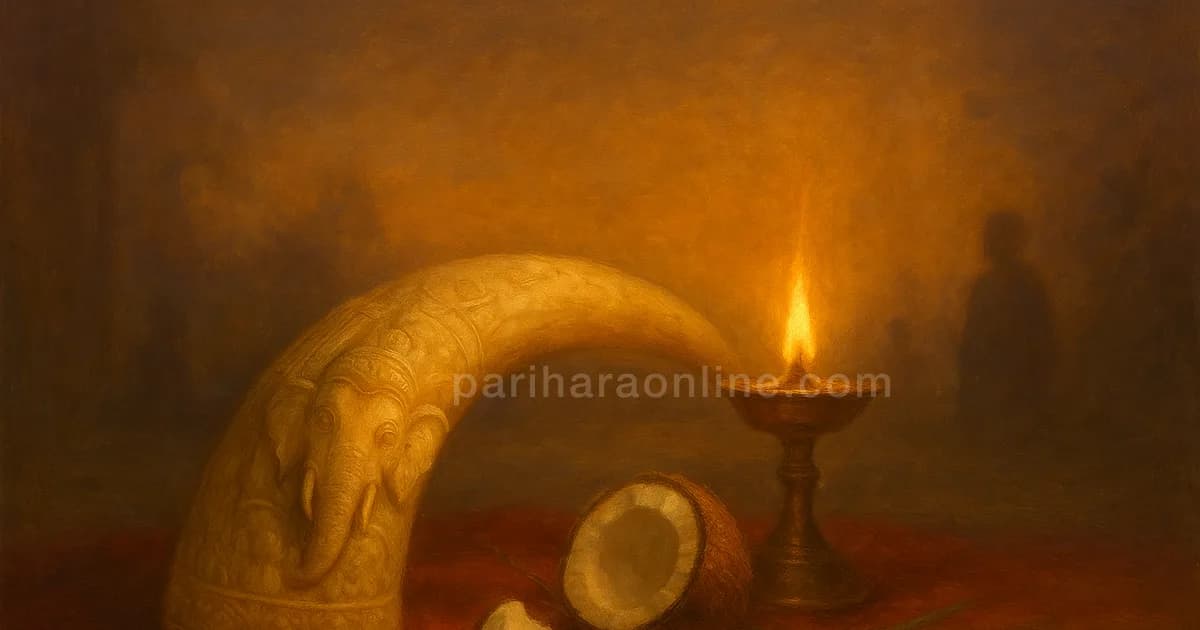
A nakshatra is one of the twenty-seven star groups the Moon passes through each month, and your birth star is the one it occupied when you were born. Each has a presiding deity, a ruling planet and a symbol. For Uttara Ashadha nakshatra the deity is unusual: not one god but the Vishvedevas, the universal gods, the whole assembly invoked together in the Vedas. Its ruling planet, or adhipati, is Surya, the Sun. Its symbols are an elephant's tusk and the planks of a bed. It spans two signs: its first quarter lies in Dhanu, the archer, and the rest in Makara rasi.
Tradition describes Uthiradam-born people as principled, patient and quietly determined, slow to start and hard to stop. I read that kind of portrait the way I read a character sketch in a novel. It is a description the tradition offers, not a destiny it hands you. If you are not sure of your own star, how to find your nakshatra takes a birth time and place and does the rest, and anyone wondering why the sky gives two answers can read Vedic vs Western astrology.
What does it take to win in the end?
The tusk is the clue. In the popular telling, Ganesha broke off his own tusk to keep writing the Mahabharata as Vyasa dictated, rather than let the poem pause; the story of Ganesha's broken tusk tells it properly.
What moves me is that the victory in that story is not a battle. It is a manuscript finished. Most of our victories are like that: a degree completed at night after the children sleep, a loan paid off, a difficult parent looked after for years. Nobody applauds the last page. Uthiradam is the star of the last page.
Avvaiyar's Vinayagar Agaval, the long Tamil hymn to Ganesha, is sung in many homes each morning for steadiness, for a mind that does not wander from its purpose. I learned it as a boy without understanding a word. Now I understand only a few lines, and they are enough. If you want to meet the poet herself, I have gathered a few of Avvaiyar's wisdom sayings, most of them short enough to learn between two train stops.
Temple, star day and Ganapathy
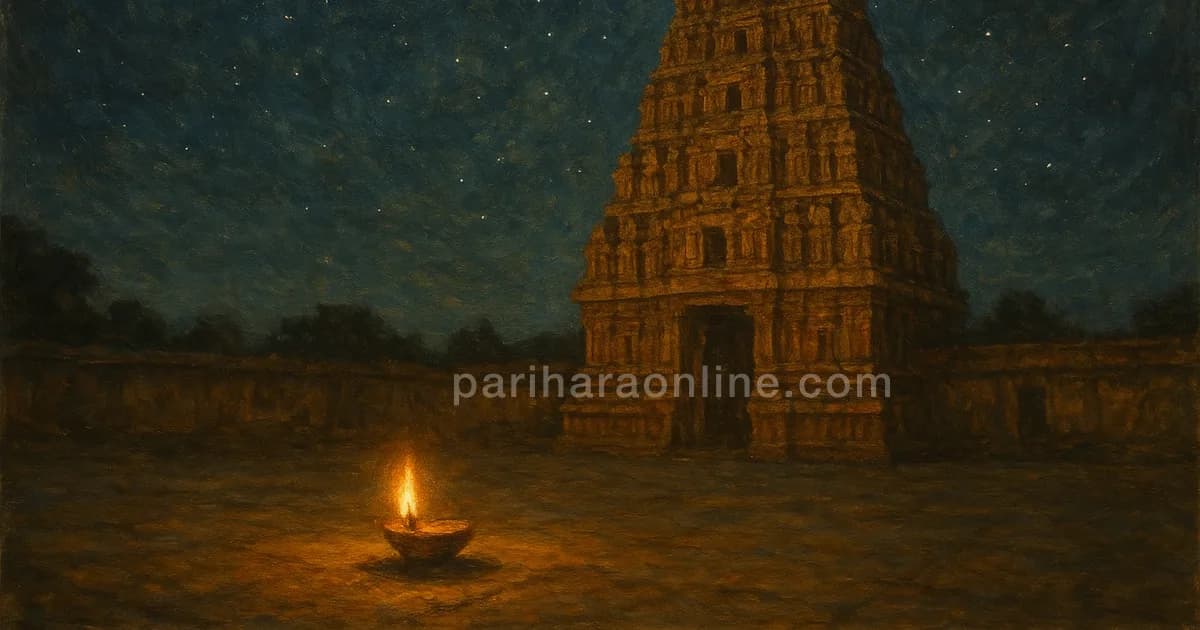
The Brahmapureeswarar temple at Keezha Poongudi, near Sivaganga in Tamil Nadu, is the temple the widely shared Tamil star list pairs with Uttara Ashadha. Uthiradam people make the trip when they are in India; I know a family in Houston who plan their visits home around it.
Because the Sun rules this star, Sunday prayers to Surya are a natural fit: a little water offered towards the morning sun, a line of the Gayatri, a moment facing east. Because of the tusk, Ganesha is close to Uthiradam people too. On Uthiradam day each month, a short Ganapathy archana, the offering of his names with flowers, or a coconut broken before his image, is a simple way to mark it.
The Uthiradam of your birth month is your star birthday, which many South Indian families keep more carefully than the calendar one, sometimes with a homam for long life, as described in the star birthday and the ayushya homam. For Uthiradam, many families begin the day with a coconut for Ganesha, the remover of obstacles, before anything else. The panchangam, the traditional almanac, gives the day.
One small thing for this week
My son's project got a decent grade. What stayed with me was not the grade but the moment at midnight when he could have left it undone and did not.
This week, finish one thing you started and left. A letter, a drawer, a book with a bookmark stuck at chapter four. Uthiradam's victory is not the loudest; it is the last one standing.
Questions people ask
Which temple is associated with Uthiradam nakshatra?
The widely cited Tamil list of nakshatra temples names the Brahmapureeswarar temple at Keezha Poongudi, near Sivaganga, as the Uthiradam nakshatra temple. Uthiradam-born devotees often visit on their monthly star day, or arrange archana there from afar. Many also pray to Ganesha, whose tusk is one of the star's symbols, before beginning important work.
Who are the Vishvedevas, the deities of Uttara Ashadha?
The Vishvedevas are a group of Vedic gods, literally 'all the gods', invoked together in the Rig Veda and in ancestral rites. As the presiding deity of Uttara Ashadha nakshatra, they represent universal support and shared goodness. Tradition therefore reads the star as one of principle and collective strength, where success is earned fairly and lasts.
What are Uthiradam star characteristics?
Tradition describes Uthiradam-born people as honest, principled, patient, responsible and slow to give up, often succeeding later rather than earlier, with rigidity as a possible shadow. The tusk symbol suggests strength with purpose. These Uthiradam star characteristics are tradition's descriptions, not certainties; the full chart and one's own effort shape life far more.
Enjoying this?
To get more Nakshatra posts like this, subscribe for free.
Written by
The Sunday column: festivals and rituals meeting ordinary weeks
Manikandan writes the Sunday column, where festivals and rituals meet commutes, hospital corridors and video calls with parents far away. Each piece closes with one small thing to carry into the week ahead.