Pradosham Meaning: The Twilight Hour for Shiva
Pradosham meaning: the twilight window twice a month when Shiva is worshipped with Nandi, the story of the churned ocean, and why dusk matters to Shaivas.
· 4 min read
In short
Pradosham is the twilight period on the thirteenth lunar day of each fortnight, when Shiva and Nandi are worshipped together.
Tradition links it to Shiva drinking the poison from the churning of the ocean and dancing at dusk.
Devotees attend the abhishekam to Nandi or keep a fast until evening.
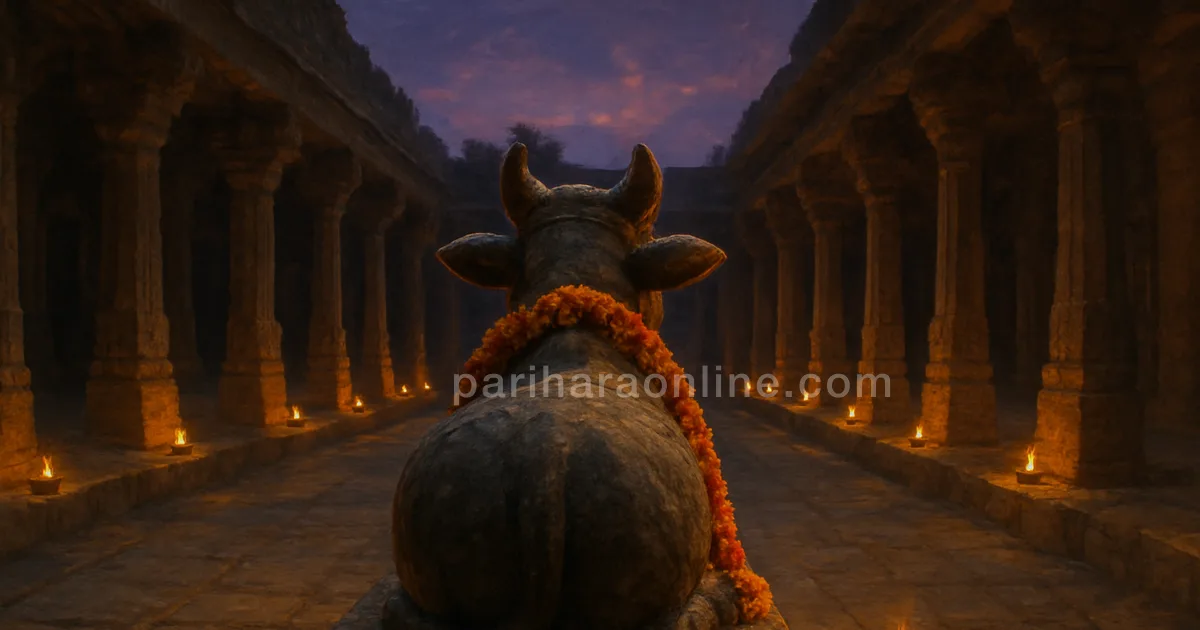
Pradosham meaning, in one line: it is the twilight hour on the thirteenth lunar day of each fortnight, set aside for Shiva, twice a month. Walk into a Shiva temple in Tamil Nadu at that hour and you will notice something odd. The crowd is not pressed at the inner shrine. It is packed around Nandi, the stone bull who sits facing the sanctum, watching milk, honey and sandal paste poured over his head. The story explains why the bull gets the attention. The story is really about swallowing what burns, and what it costs to do so gracefully.
Pradosham meaning: the twilight of the thirteenth day
Each lunar fortnight has fifteen tithis, lunar days, and the thirteenth is Trayodashi. Pradosham falls on the Trayodashi of both the waxing and the waning fortnight, in the window around sunset, roughly the hour and a half on either side of it in many temple traditions. Pradosha itself means the beginning of night, the hinge between day and dark.
When Trayodashi falls on a Saturday, it becomes Shani Pradosham, considered especially significant. Many devotees keep the pradosha vratham, a fast through the day broken after the evening worship. And once a month, the very next night after a waning Pradosham, comes Masa Shivaratri, the monthly night of Shiva; once a year it swells into Maha Shivaratri.
Why is Nandi worshipped at Pradosham?
The answer begins with the churning of the ocean. In the Bhagavata Purana, the gods and the demons, needing the nectar of immortality, churn the cosmic ocean of milk, using a mountain as the churning rod and the serpent Vasuki as the rope. Before any nectar appears, something else comes up: halahala, a poison so fierce it begins to burn the three worlds. Everyone flees. Only Shiva comes forward. He gathers the poison and drinks it, and Parvati, pressing her hand to his throat, stops it there. His throat turns blue. He becomes Neelakantha, the blue-throated one.
Temple tradition in South India adds the part that explains the crowd around the bull. The poison was swallowed, the tradition says, at twilight on Trayodashi. Relieved, Shiva danced between the horns of Nandi, and the gods, gathered around the bull, watched. So at Pradosham, devotees stand behind Nandi and look through the gap between his horns towards the lingam. They are trying to see what the gods saw.
So why is Nandi worshipped on Pradosham? Because he is the stage of the dance. He is also the perfect devotee, the one who never looks anywhere but at Shiva. To stand behind him is to borrow his gaze.
The idea behind twilight worship
Pradosham significance runs deeper than a single story. Dusk, sandhya, is a threshold hour in the tradition, the time when day and night meet and the mind tends to wander into worry. Most of the world's lamp rituals sit here, as the dusk lamp ritual describes. Pradosham places Shiva exactly at that hinge.
And the story placed there is not a story of victory. Nobody is killed. Shiva simply takes in something poisonous and does not let it spread, neither spitting it out onto the world nor letting it reach his heart. It stays in his throat, visible, a blue mark he wears openly. This is a very adult image. Most of us carry something bitter: a grief, an unfairness, a word said at the wrong time. The story does not promise to remove it. It shows a way to hold it.
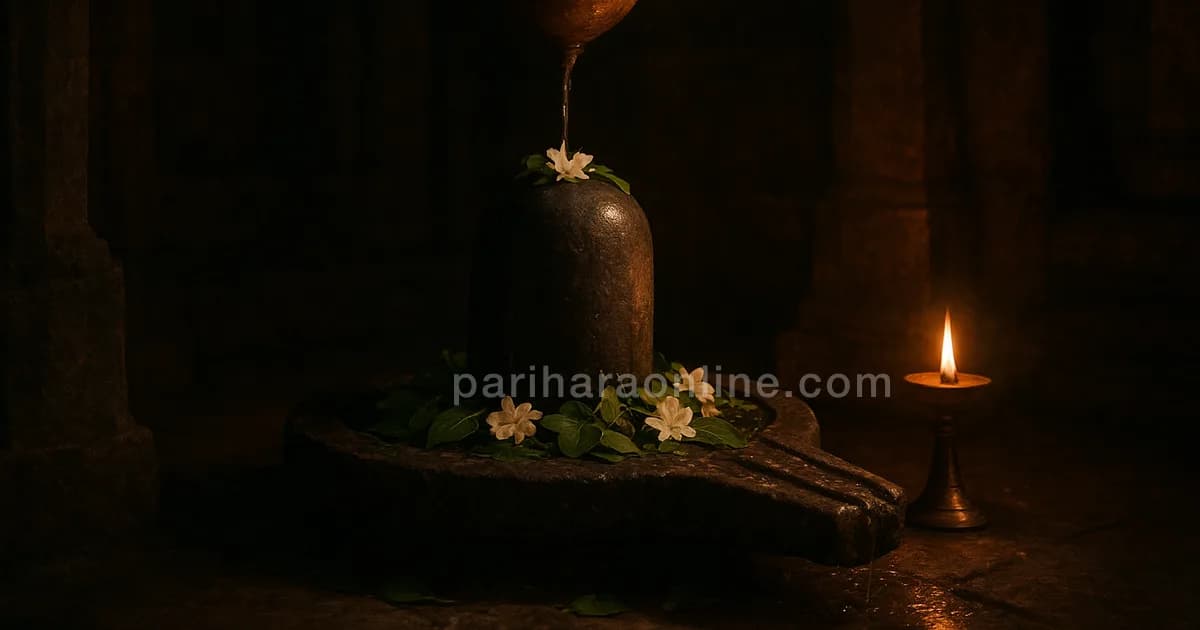
Abhishekam, the ritual bathing of the deity, is poured over Nandi first at Pradosham, then over the lingam. Devotees chant the five-syllable mantra, whose meaning is unpacked in Om Namah Shivaya, and walk around the shrine in a particular zig-zag path in some temples. If you want to know why chanting works on the mind at all, what is a mantra is a good start.
Ten minutes at the next Pradosham
You do not need a temple. On the next Pradosham, check the panchangam for the day, and at sunset, stop wherever you are for ten minutes. Light a lamp. Say the five syllables a few times, or simply sit. Then name, silently, one bitter thing you are carrying, and imagine holding it the way Shiva does, in the throat, not the heart.
If the practice sits well with you, it can grow into a longer night; a Shivaratri vigil at home shows how. But the twilight hour is enough to begin.
Questions people ask
What is Pradosham and when does it happen?
Pradosham falls on Trayodashi, the thirteenth lunar day, in both the waxing and waning fortnights, so it comes about twice a month. The worship happens in the twilight window around sunset, roughly ninety minutes before and after. When it falls on a Saturday it is called Shani Pradosham and considered especially powerful by many devotees.
Why is Nandi worshipped during Pradosham?
In Shaiva tradition, after Shiva swallowed the halahala poison during the churning of the ocean, he danced in joy between the horns of Nandi, his bull and devoted gatekeeper. So on Pradosham temples bathe and decorate Nandi first, and devotees look at the Shiva linga through the space between Nandi's horns.
What is the story behind Pradosham?
The Shiva Purana and other texts tell how gods and demons churned the ocean for amrita, but first brought up a deadly poison. Shiva drank it to protect the world, and Parvati held his throat so it stayed there, turning it blue. The twilight of that day became Pradosham, a time of gratitude to Shiva.
How do you observe Pradosha vratham at home?
Many devotees fast through the day or eat simply, then at twilight light a lamp, offer water, milk or bilva leaves to a Shiva image, and chant Om Namah Shivaya or the Shiva Panchakshara stotram. The fast is broken after the evening worship. Visiting a Shiva temple for the Nandi abhishekam is a treasured addition when possible.
Enjoying this?
To get more Pradosham posts like this, subscribe for free.
Written by
Reads the old stories for what they still mean
Hariharan writes about the myths, symbols and festival stories that most of us grew up hearing but were rarely asked to think about. He tells the story first, then asks what it is really about, and leaves the conclusion to you.