Holika Dahan at Home: A Small, Safe Fire Ritual
Holika Dahan at home: a small, safe version of the Holi bonfire ritual with a lamp or brazier, what to offer, what to let go of, and simple safety steps.
· 4 min read
In short
Holika Dahan is the bonfire lit on the full-moon evening of Phalguna, the night before colour-day Holi, to recall Prahlad's protection from fire.
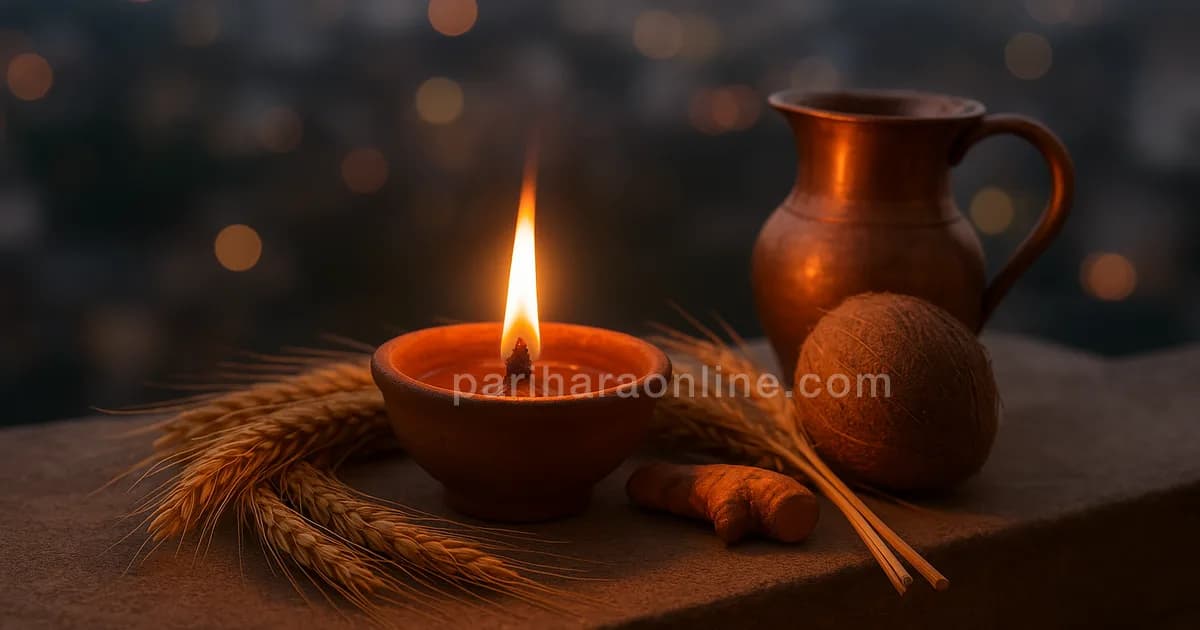
At home, a large ghee lamp or a small contained flame, circled with offerings of grain and coconut, keeps the ritual's meaning safely.
Fire is the oldest technology human beings have for letting go. You do not need a village bonfire to use it, only a flame and a clear intention. Holika Dahan at home can be as small as a large ghee lamp on a metal plate, circled slowly with a handful of grain, on the full-moon evening before the colours of Holi. Done with attention, that small flame does exactly what the big bonfire does: it gives you a place to put down what you are carrying.
Holika Dahan at home: what the ritual is
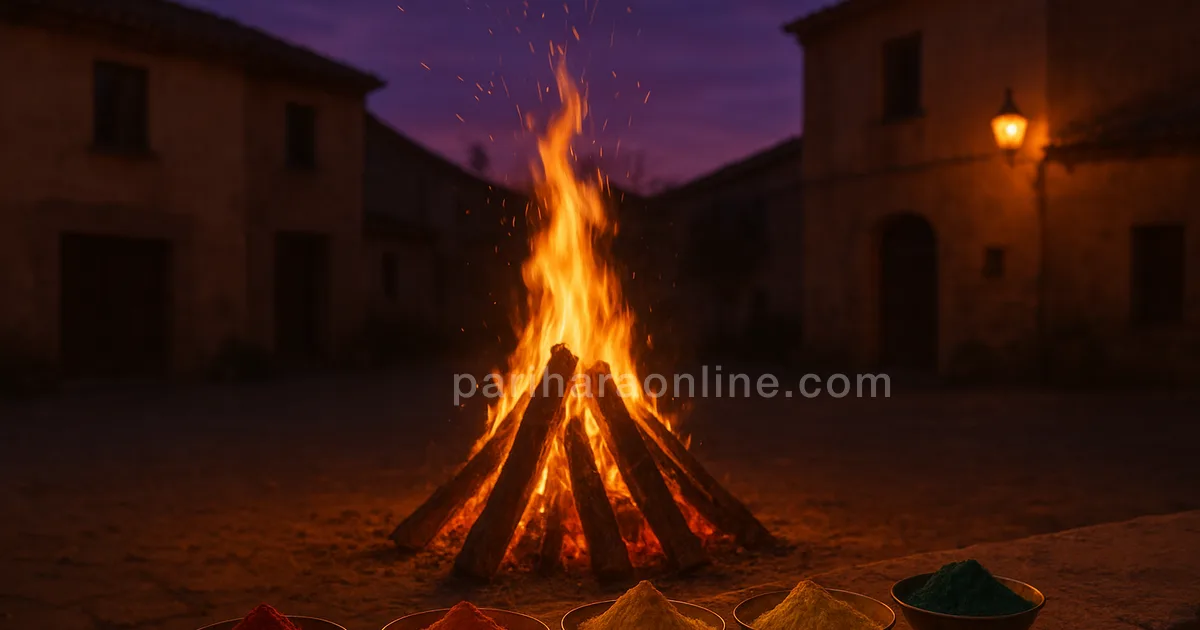
Holika Dahan, the burning of Holika, is lit on the evening of the full moon of Phalguna, the night before colour-day Holi. In villages and towns, people build a large pile of wood and dried cow-dung cakes, tie raw cotton thread around it, circle it, offer grain and coconut, and light it after sunset at the time the local almanac gives. The fire recalls Prahlad, who sat in the flames and came out unharmed while his aunt Holika burned; the full story is told in the meaning of Holi and Prahlad.
For the body, the ritual has a clear shape. You stand before heat and light. You walk around it, which brings you back to the same point again and again. You offer something into it. Then you step back. Those four movements are the whole ritual, and every one of them can be done at home.
Can you do Holika Dahan safely indoors or on a balcony?
Yes, if you shrink the fire and respect the building. A real bonfire does not belong in an apartment. Instead, choose one of these:
- A large ghee or sesame-oil lamp with several wicks, set on a steel or brass plate. The notes on choosing a ghee lamp or oil lamp help if you are unsure which to use.
- A small metal brazier or a clay pot with one dried cow-dung cake and a little camphor, used only outdoors in a yard or an open balcony where building rules allow it.
- A cluster of tea-lights on a tray, if even that feels like too much.
Whatever you choose, keep a jug of water or a small extinguisher beside you, open a window for ventilation, keep children and loose clothing at a distance, and never leave the flame unattended. If you live in a rented flat or a building with smoke alarms, the lamp is the right choice. The tradition is served by the flame, not by the size of it.
What to offer and what to release
For the Holika Dahan rituals themselves, keep the offerings simple and dry:
- A handful of roasted grain: barley, wheat, or chickpeas. In North India new wheat or green chickpeas are traditional, since the festival marks the spring harvest.
- A small piece of dry coconut.
- A pinch of turmeric and a few grains of rice.
- A slip of paper with one word on it, the thing you want to burn.
Stand in front of the flame. Take three slow breaths. Then walk around it clockwise three or seven times. With a lamp on a table, walking around it may not be possible, so simply turn in place, or move the plate in three slow circles in front of you. With each round, offer a little grain.
Now the slip of paper. Write one word: anger, fear, a person's name you are tired of resenting, a habit you want to end. Hold it for a moment. Then burn it in the camphor or over a separate small flame in a steel bowl, not over the ghee lamp. Watch it curl. Many people find this is the moment the ritual lands in the body. The same principle sits beneath every fire ritual, as the piece on homam and letting go explains.
After the flame
Do not rush off. Sit still for two minutes after the last offering. Feel the warmth on your face. Notice whether your shoulders have dropped. Then put the flame out safely, or let the lamp burn down under watch.
Before bed, wash your hands and face slowly with cool water, as if you are starting fresh for the morning. Tomorrow is the colour day, and in many places far from India it moves to the nearest weekend; Holi in America looks at how families handle that, and the Hindu festival calendar for the USA helps you plan around it. Wherever you play, you will go into the colour a little lighter. Try it once, and see whether you want the fire back every spring.
Questions people ask
How can I do Holika Dahan puja at home?
On the evening of Holika Dahan, clean a safe spot and light a large ghee lamp or a small contained fire in a metal or clay vessel. Offer turmeric, kumkum, roasted grains, a coconut or jaggery. Walk around it three or seven times, praying for protection and the release of what weighs on you. Keep water nearby and never leave it unattended.
What do you offer in the Holika Dahan fire?
Traditional offerings include roasted wheat or barley ears, grams, coconut, jaggery, turmeric, kumkum, raw cotton thread wound around the pyre, and cow-dung cakes. Some families roast new grain in the fire and eat it as prasad. A personal practice is to write down a habit or grudge and offer that too, symbolically burning it.
Is it safe to light a Holika fire in an apartment?
An open bonfire indoors is not safe and may break building rules. Instead, use a large oil or ghee lamp, or a small flame in a sturdy metal or clay vessel on a balcony, away from curtains and with water at hand. The meaning lies in the intention and the circling, not in the size of the fire.
Enjoying this?
To get more Holi posts like this, subscribe for free.
Written by
Writes about practice: attention, breath, the body, the lamp
Archana writes about ritual as something you do rather than something you believe: the lamp, the breath, the fast, the few quiet minutes before the day begins. Her pieces usually end with a small practice to try for a week and notice what changes.