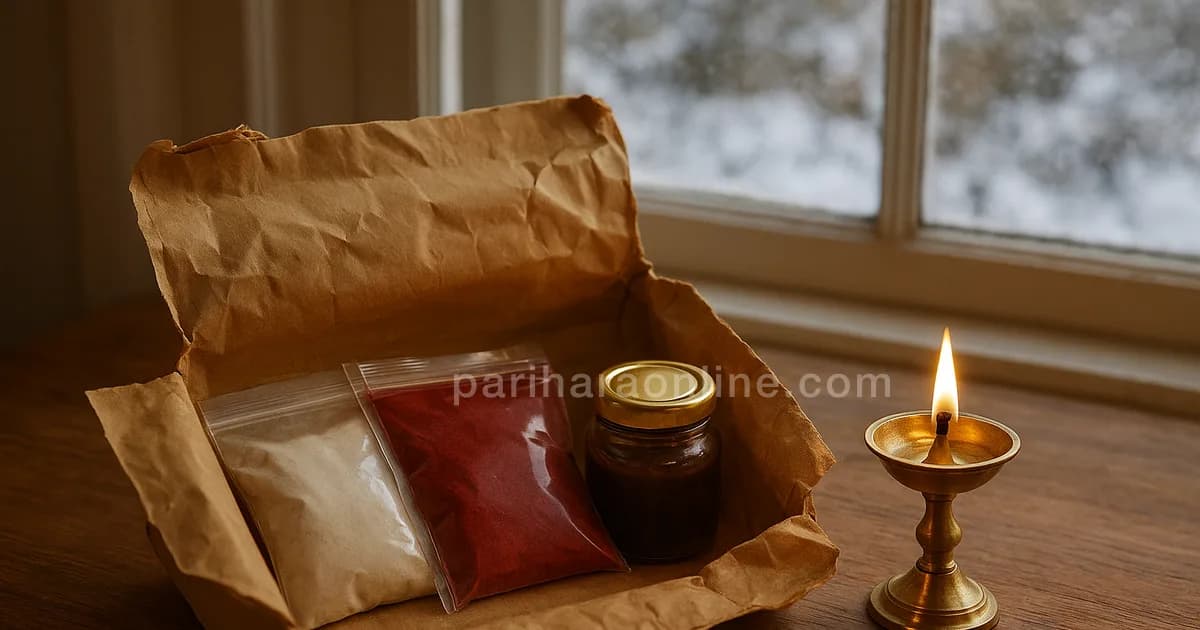
What to Do With Prasadam When It Arrives
What to do with prasadam when it arrives: how to receive it, when to eat it, how to use vibhuti and kumkum, and how to return leftovers to nature.
· 4 min read
In short
Receive prasadam with clean hands, place it at your altar first, then eat or use it with attention, ideally sharing some with others.
Old or spoiled prasadam is traditionally returned to nature, under a tree, in a plant pot or flowing water, not thrown in the trash.
Prasadam is not a souvenir. It is food, ash or flowers that finished a ritual, and it asks you to finish it too, by receiving it with attention. If you are wondering what to do with prasadam when a packet arrives from a temple, the answer is simple: wash your hands, place it at your altar first, then eat or use it slowly, and share some with others. Whatever is left over, or has gone stale, goes back to the earth, not into the trash can.
Receiving it
The moment of receiving matters more than people think. At a temple, you would cup your hands, take the prasadam with the right hand or with both hands together, touch it to your forehead and only then eat. Every part of that is a signal to the body: this is not a snack.
Do the same at home, even if the prasadam came by post.
- Wash your hands before you open the packet. Wash your face too, if you can.
- Take it to your altar, or to any clean spot where you pray, and place it there for a minute. Light a lamp if you like.
- Receive it with the right hand, or both hands, and bring it to your forehead or eyes briefly.
Try this: before you open it, pause for three breaths. You will notice that the hands slow down on their own. That slowing is the point. There is a more detailed guide to how the parcels travel and what usually comes in them in prasadam delivery to the USA.
What to do with prasadam, item by item
Sweets and panchamritham. Eat a little first thing in the morning, before other food, when the stomach is empty and the mind is not yet crowded. One spoonful is enough. Share the rest with family, a neighbour, a friend.
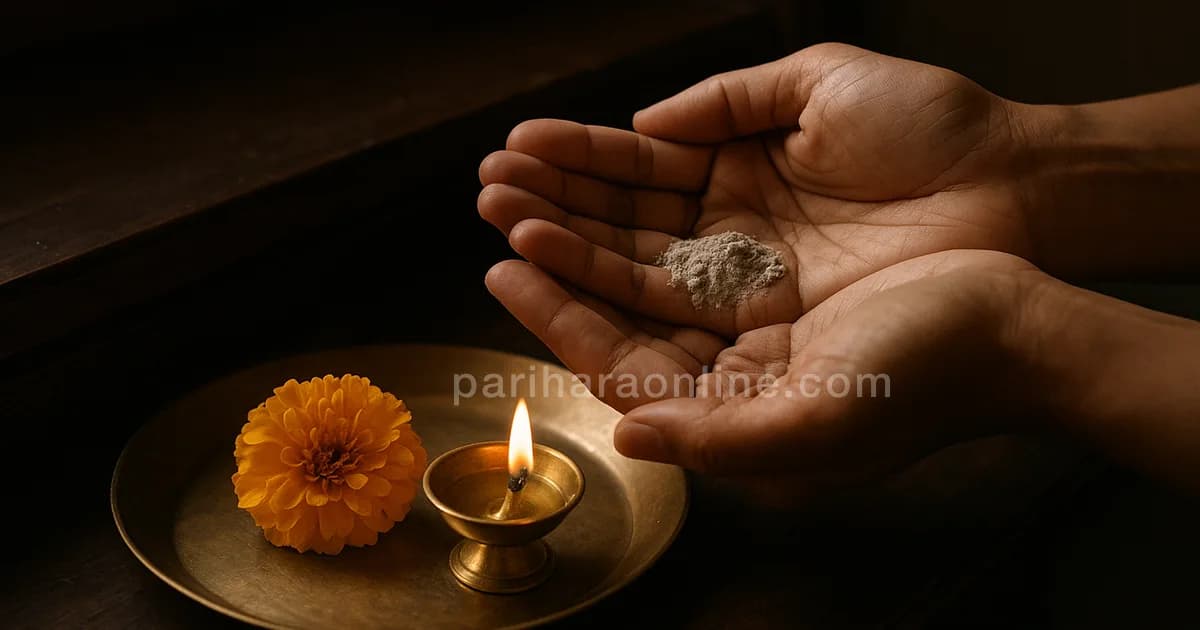
Vibhuti, or sacred ash. Take a small pinch with the ring finger of your right hand and draw it across the forehead, or place a dot between the eyebrows. Some people also touch it to the throat, and many put a tiny amount on the tongue. Keep the rest in a clean, dry, closed container at your altar.
Kumkum and turmeric. Kumkum, the red powder offered to the Goddess, is worn as a dot at the centre of the forehead or at the parting of the hair. Turmeric can be added to the water you use to clean the altar.
Akshata, the unbroken rice grains. Sprinkle a few on the heads of family members as a blessing, especially children and elders on birthdays. Keep a small pinch in your rice container; many families do.
Sacred threads. Tie on the right wrist for men and the left for women, or as your family custom says. Leave it on until it frays and falls off by itself.
Is it ever okay to throw prasadam away?
Traditionally, no, not into household garbage. But everything eventually spoils, and the tradition has a clear answer for that: return it to nature.
- Dry items such as old vibhuti, flowers and threads can go at the foot of a tree, into a garden bed or a large plant pot.
- Food that has spoiled can be buried or composted.
- Some families release items into flowing water, though check local rules before putting anything in a river or lake.
This is not superstition about bad luck. It is a way of keeping the attention intact to the very end. You received it carefully; you let it go carefully. The idea behind this, that prasadam is grace returned rather than food handed out, is told beautifully in why prasad is shared. And the same attitude of thanks can be carried into ordinary meals, as explored in prasad and gratitude.
Try this for a week
Each morning, before you check your phone, go to your altar. Take a small pinch of vibhuti. Put it on your forehead. Then take three slow breaths, the exhale longer than the inhale.
That is all. It takes less than a minute. But notice what happens to the first ten minutes of your day. The phone can wait; the ash on your forehead reminds you, every time you pass a mirror, that you began the day with attention rather than with notifications. Many people find the mornings change shape. If you want to go further, look at the old practice of waking in the brahma muhurta, the hour before dawn, and at how meditation and puja meet in exactly this kind of small daily act.
Questions people ask
How do you use vibhuti prasadam at home?
Take a small pinch with the ring finger of your right hand and apply it across the forehead, or as a dot between the eyebrows. Some people also touch it to the throat. Many take a tiny amount on the tongue. Store the rest in a clean, dry, closed container at your altar and use it daily or on special days.
How should I dispose of old prasad?
Traditionally, prasadam is never thrown in household garbage. Dry items such as vibhuti or flowers can be placed at the foot of a tree, in a garden or a large plant pot. Food that has spoiled can be buried or composted. Some families release items into flowing water, though check local rules before putting anything into rivers.
Can I share prasadam with friends who are not Hindu?
Yes. Prasadam is meant to be shared, and offering it to anyone is considered a blessing, not a conversion. Explain simply that it was offered at a temple and is shared as a sign of goodwill. Let people decline without awkwardness, and mention ingredients such as ghee or nuts for those with dietary needs.
Enjoying this?
To get more Prasadam posts like this, subscribe for free.
Written by
Writes about practice: attention, breath, the body, the lamp
Archana writes about ritual as something you do rather than something you believe: the lamp, the breath, the fast, the few quiet minutes before the day begins. Her pieces usually end with a small practice to try for a week and notice what changes.