Modak for Ganesh Chaturthi: Steamed Kozhukattai
A modak recipe for Ganesh Chaturthi from a US kitchen: soft rice flour shells, coconut and jaggery filling, steamed kozhukattai, and how many to offer Ganesha.
· 4 min read
In short
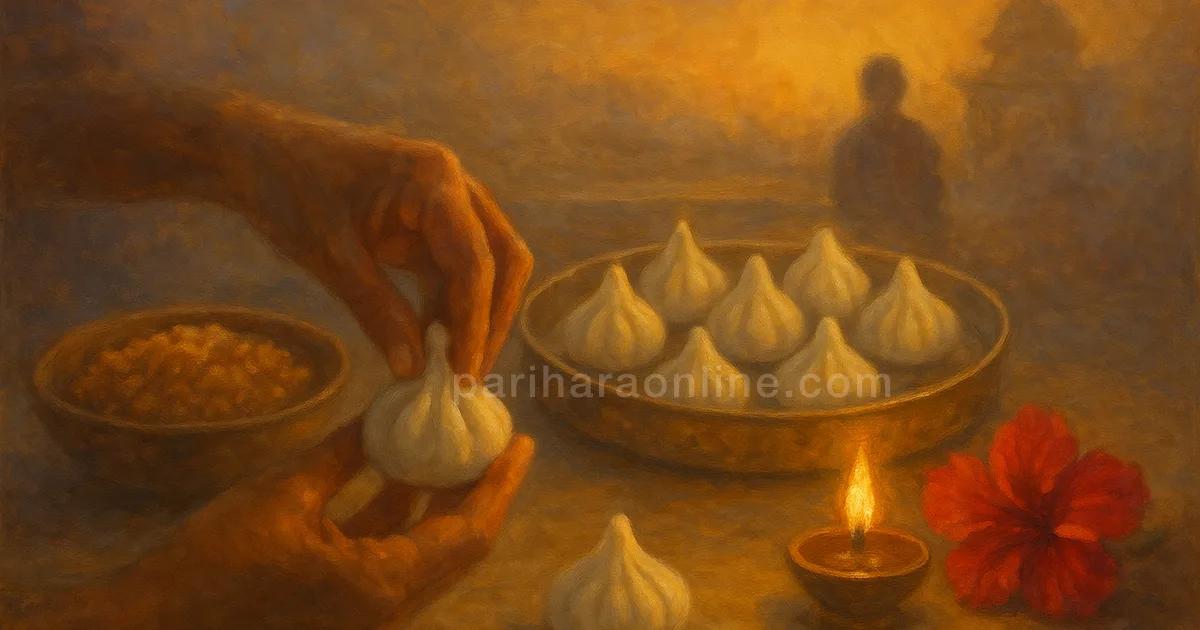
Steamed modak, or kozhukattai, is a rice flour shell filled with coconut, jaggery and cardamom, pleated to a point and steamed for about ten minutes.
It is Ganesha's favourite sweet in tradition, offered on Ganesh Chaturthi, usually August or September, often as twenty-one pieces.
The first few modaks will tear, and that is fine. This modak recipe for Ganesh Chaturthi is for the steamed kind, called kozhukattai in Tamil homes and ukadiche modak in Maharashtra: a sweet coconut and jaggery filling sealed inside a thin rice-flour shell. It is less about perfect pleats and more about sitting at the counter for an hour with your hands in warm dough. Give yourself that hour, and the torn ones become part of the story.
Modak recipe for Ganesh Chaturthi: filling and dough
For the filling (poornam)
- 100 g fresh or frozen grated coconut (1 cup), thawed
- 100 g grated jaggery (½ cup)
- ½ teaspoon cardamom powder
- 1 teaspoon ghee
For the dough
- 150 g fine rice flour (1 cup)
- 250 ml water (1 cup)
- A pinch of salt
- 1 teaspoon ghee or oil
Method
- Melt the jaggery with two tablespoons of water in a pan, strain out any grit, and return it to the heat.
- Add the coconut and cook, stirring, until the mixture thickens, turns glossy and comes together in a sticky mass. Stir in cardamom and ghee. Let it cool, then roll into small balls.
- For the dough, bring the water to a boil with salt and ghee. Lower the heat and pour in the rice flour, stirring quickly so no lumps form.
- Turn off the heat, cover, and leave it for five minutes.
- While it is still warm, knead it smooth with greased palms. Keep it covered with a damp cloth so it does not dry.
How do you shape kozhukattai without a mould?
Take a lime-sized ball of dough. Flatten it in your palm and press it into a small cup, thin at the edges and a little thicker at the base. Put a ball of filling inside.
For the classic modak, pinch the edge into pleats with thumb and forefinger, then gather the pleats upward and twist them to a point. For something simpler, fold the cup into a half-moon and seal the edge. Both are traditional.
If the pleats frustrate you, the Indian store sells plastic modak moulds. Grease the mould, press dough into it, fill, close and unmould. Nobody at the pooja will mind.
Steam the modaks on a greased plate or banana leaf in an idli steamer or a steamer basket for ten to twelve minutes, until the shells look slightly translucent.
Notice what happens to your attention while you do this. Hands in warm dough, one pleat at a time, and for once the mind has nowhere else to be.
Why modak, and when?
Ganesha is pictured holding a modak in his hand, and tradition reads it as sweetness hidden inside a plain shell, the reward inside the effort. The rest of his form, beginning with the story of Ganesha's elephant head, carries meanings of its own.
Ganesh Chaturthi falls on the fourth day of the waxing moon in the month of Bhadrapada, usually August or September. Modaks are also made on Sankatahara Chaturthi, the monthly fourth day after the full moon. They are offered before anyone tastes them, often in a count of five, eleven or twenty-one. If the festival lands on a workday, Ganesh Chaturthi in the USA has practical ideas, including how families manage the visarjan.
The offering plate often grows around the modaks: sweet aval for Krishna is a no-cook addition, and sakkarai pongal for pooja completes a festival spread.
Let the torn ones be the family's share
This Chaturthi, make as many as your patience allows. Twenty-one if you are in the mood; five if the evening is short. Offer them warm, straight from the steamer, before the lamp.
Then do what most families quietly do: the neat ones go on the plate for Ganesha, and the torn ones, the ones that leaked a little filling, are the family's share. Nobody ever complains.
Questions people ask
What is the difference between modak and kozhukattai?
They are essentially the same offering under different names. Modak, and ukadiche modak for the steamed kind, is the Marathi name, and kozhukattai is Tamil. Tamil homes also make a savoury kozhukattai filled with spiced urad dal. Both are traditional for Ganesha, and the pleated sweet version is the most common Chaturthi offering.
How do I make ukadiche modak with rice flour from an Indian store?
Choose the finest rice flour you can find; some stores sell flour labelled specifically for modak or kozhukattai. Stir it into an equal volume of boiling water with salt and ghee, cover for five minutes, then knead while warm until smooth. Keep the dough covered with a damp cloth so it does not crack as you shape.
How many modaks are offered to Ganesha?
Twenty-one is the most widely followed number, especially on Ganesh Chaturthi, and it is linked to Ganesha in several traditions. Many families offer five or eleven on smaller days, like Sankatahara Chaturthi. What matters is that the modaks are made with care and offered before anyone eats, then shared as prasadam.
Can I use frozen coconut and a steamer basket for kozhukattai?
Yes. Frozen grated coconut from Indian stores works well once thawed and squeezed of extra water. Any steamer works: an idli steamer, a bamboo basket, or a metal rack in a covered pot. Grease the plate or line it with a banana leaf so the modaks do not stick, and steam for ten to twelve minutes.
Enjoying this?
To get more Recipes posts like this, subscribe for free.
Written by
Writes about practice: attention, breath, the body, the lamp
Archana writes about ritual as something you do rather than something you believe: the lamp, the breath, the fast, the few quiet minutes before the day begins. Her pieces usually end with a small practice to try for a week and notice what changes.