Uttara Bhadrapada (Uthirattathi): Deep Water, Calm
Uttara Bhadrapada nakshatra, Uthirattathi in Tamil: Ahir Budhnya and Shani, the serpent of the deep, the Theeyathur temple, and a week of stillness.
· 4 min read
In short
Uttara Bhadrapada, Uthirattathi in Tamil, is presided over by Ahir Budhnya, the serpent of the deep, with Shani as its ruling planet.
Tradition links the star with depth, patience and calm that holds steady under pressure.
The Sahasra Lakshmeeswarar temple at Theeyathur is traditionally associated with Uttara Bhadrapada nakshatra.
The surface of a deep lake can be rough with wind while the water a few feet down barely moves. Uttara Bhadrapada's god lives in that deep water, and the practice this star offers is learning to go there. Uttara Bhadrapada nakshatra, Uthirattathi in Tamil, is the twenty-sixth of the twenty-seven birth stars. Tradition links it with depth, patience and a calm that holds under pressure, and it gives you a very practical way to find that calm in your own body.
Uttara Bhadrapada nakshatra: the serpent of the deep and Saturn
Your birth star is simply where the Moon was, among its twenty-seven stations, when you were born. Uttara Bhadrapada nakshatra is presided over by Ahir Budhnya, "the serpent of the depths", a Vedic deity who lives at the bottom of the waters. Its adhipati, or ruling planet, is Shani, Saturn, the slowest of the planets. The star lies wholly in Meena, the sign of the fish.
Its symbols are the back legs of a funeral cot and a snake in water. The cot is shared with the star before it, Purva Bhadrapada, which holds the front legs. Together the two stars are a single image of endings, and of what carries us through them.
In the traditional portrait, Uthirattathi-born people are calm, wise, patient and self-controlled, slow to anger and slow to decide. That may fit you or it may not. It is a traditional sketch, not a prescription.
Where does calm actually come from?
In the Rig Veda, Ahir Budhnya is invoked beside Aja Ekapada, the one-footed god of the previous star. One holds up the sky; the other lies at the foundation, beneath the waters, stable and unseen. The hymns do not say much more about him. Perhaps that is fitting. The deep does not explain itself.
Shani, the ruling planet, is often feared, and most of what is written about him dwells on difficulty; what sade sati actually means is a calmer place to start. But the tradition also treats Shani as a teacher of patience. He moves slowly because some things cannot be hurried. Pair a slow planet with a god of the deep and you get a very specific instruction: go down, and stay there a while.
You do not have to take any of this as cosmology to use it. The body has its own depth. When you are agitated, the breath lives high in the chest, the shoulders creep up, the eyes dart. Calm tends to show up lower. A long exhale. A still spine. Eyes resting low, not scanning. Many people find that simply lengthening the out-breath is enough to move them a few feet down from the choppy surface. Nothing supernatural is being claimed here; it is just where the stillness tends to be found. For a structured way in, pranayama before pooja is short and easy to keep.
Theeyathur and the still hour
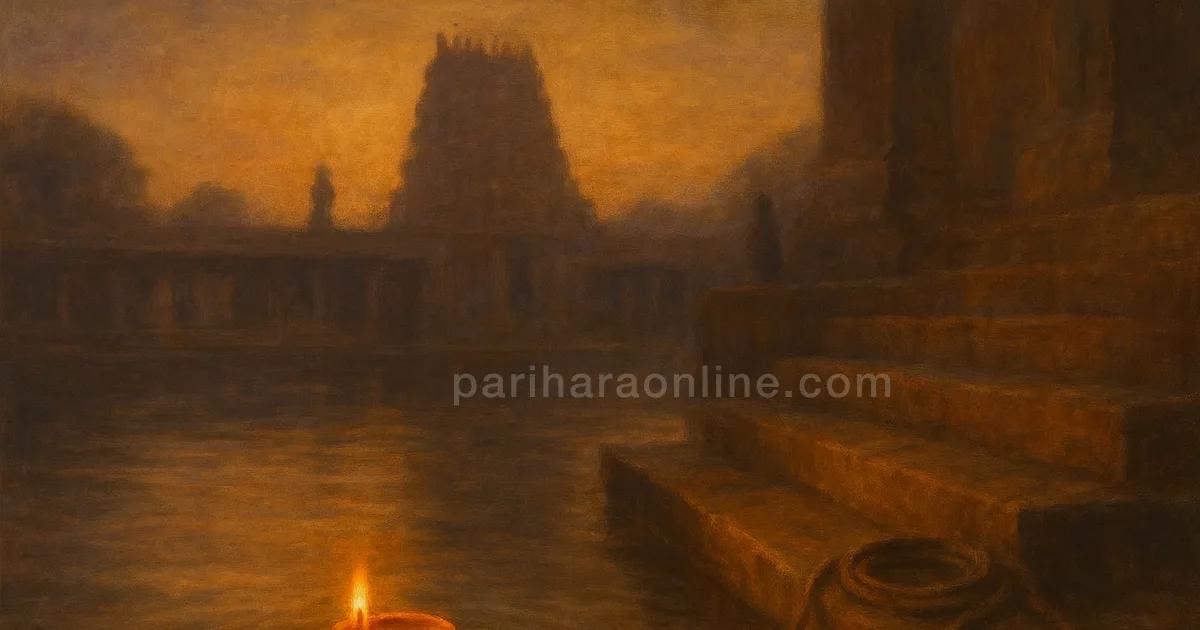
The Sahasra Lakshmeeswarar temple at Theeyathur, near Avudaiyarkoil in Tamil Nadu, is the temple Tamil star lists pair with Uttara Bhadrapada nakshatra.
Because Shani rules the star, Saturday sesame-oil lamps are a traditional observance. Light one at dusk and sit with it. On Uthirattathi each month, try sitting still for ten minutes before any work begins. Not meditating, necessarily. Just sitting, with the spine upright and the breath long. Begin by saying why you are doing it; that small spoken intention is the sankalpam of the practice.
Your star birthday, the Uthirattathi of your birth month, works best as a slow, quiet day: fewer plans, longer meals, an early night.
The long exhale at night
Each evening, lie down on your back and breathe out for twice as long as you breathe in, ten times. Count four in and eight out, or whatever is comfortable, as long as the exhale is longer. Do not force it. Notice what happens to the jaw and the hands.
And on your Uthirattathi day, make one decision only after sleeping on it. Not a big one necessarily. Just one choice you let sink to the bottom overnight before you pick it up again. The last star of the zodiac, Revati, is about safe journeys; this one is about knowing where the still water is before you set out.
Questions people ask
Which temple is the Uthirattathi nakshatra temple?
The widely cited Tamil list of nakshatra temples names the Sahasra Lakshmeeswarar temple at Theeyathur, near Avudaiyarkoil in Pudukkottai district, as the Uthirattathi nakshatra temple. Uthirattathi-born devotees often visit on their monthly star day or on Saturdays, since Shani rules the star, or arrange archana there from afar.
What is the meaning of Ahir Budhnya?
Ahir Budhnya means the serpent of the deep, or the serpent at the bottom. In the Rig Veda this deity is invoked alongside Aja Ekapada and is associated with the foundations beneath the cosmic waters. As the deity of Uttara Bhadrapada, Ahir Budhnya gives the star its association with depth, hidden wisdom and steady calm.
What are Uthirattathi star characteristics?
Tradition describes Uthirattathi-born people as calm, wise, disciplined, compassionate and good at handling pressure, sometimes slow to act or inclined to withdraw. The serpent resting in deep water captures that stillness. These Uthirattathi star characteristics are tradition's descriptions rather than predictions; the full chart and personal choices shape a person far more.
Enjoying this?
To get more Nakshatra posts like this, subscribe for free.
Written by
Writes about practice: attention, breath, the body, the lamp
Archana writes about ritual as something you do rather than something you believe: the lamp, the breath, the fast, the few quiet minutes before the day begins. Her pieces usually end with a small practice to try for a week and notice what changes.