Thirunallar Saniswaran Temple: Nala's Release
Thirunallar temple and the story of King Nala, freed from Shani's hardship after bathing in Nala Theertham, plus how to offer a Saturday pooja from abroad.
· 4 min read
In short
The Thirunallar temple near Karaikal is a Shiva temple where Shani has a shrine, famous for the story of King Nala's release from hardship.
Its sthala purana says Nala bathed in the temple tank, now Nala Theertham, and was freed from Shani's influence.
Families abroad often offer a pooja here in their name during a Shani transit.
The Thirunallar temple, near Karaikal on the Tamil coast, is a Shiva temple first. Shani, the planet of time and discipline, stands in a niche near the entrance, and most visitors come for him. But you pass Shani on the way to Shiva, and that arrangement tells you most of what you need to know about how the tradition sees hardship. It is real, it has a place, and it is not the one in charge.
Who was Nala, and what happened at the Thirunallar temple?
The story of Nala and Damayanti is told in the Vana Parva of the Mahabharata, as a tale to console the Pandavas in exile. Nala was a good king, skilled with horses and generous with guests. A dark power found a small lapse in him, a missed ritual washing of the feet, and entered him. In the Mahabharata that power is Kali, the spirit of the age of quarrels; the Tamil tellings linked with Thirunallar give the role to Shani. Nala lost his kingdom at dice, wandered into the forest, abandoned Damayanti while she slept because he could not bear her seeing him ruined, and was bitten by a serpent that twisted his body so that no one knew him.
It is a long story of losing everything. The temple's sthala purana, its local history, adds an ending. After years of wandering, Nala came to this place, bathed in the tank, and was released from Shani's grip. Shani, in this telling, is not the villain. He is honoured as the one who teaches, and then lets go. The tank is still called Nala Theertham.
When my aunt in Chennai hears that someone is going through Shani's period, she sighs as if hearing of an illness. Shani sade sati explained sets out what Jyotish, traditional Indian astrology, actually says about it. Thirunallar says something quieter. The hard years are a chapter, not a sentence.
Darbaranyeswarar and the Shani shrine
The presiding deity is Shiva as Darbaranyeswarar, lord of the forest of darbha grass, the sacred grass used in rituals. Thirunallar is one of the Navagraha sthalas, the nine planet temples clustered around Kumbakonam and the Kaveri delta, each linked with one graha. If you are curious how people move between them, the guide to navagraha temple worship is a good map.
Devotees are asked to pray to Shiva first and Shani second. I understood this better once I stopped thinking of it as protocol. You go to the one who holds the whole of time before you go to the one who governs a difficult stretch of it. Perspective first, then the particular problem.
What does the Nala Theertham bath mean?
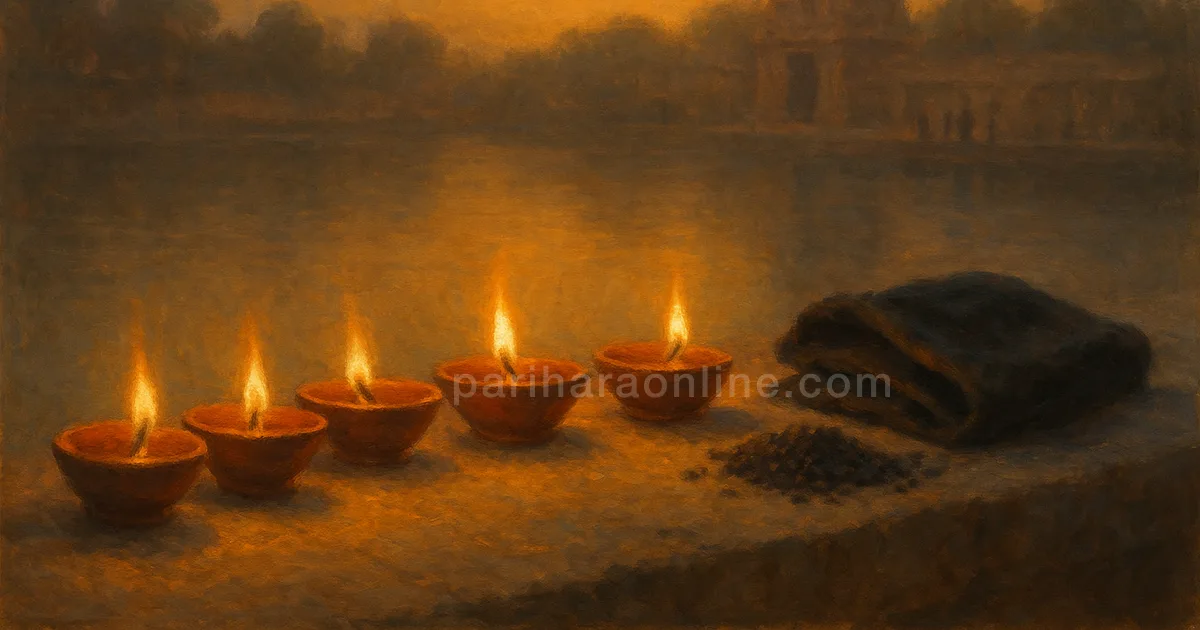
Pilgrims bathe in Nala Theertham, often in old clothes that they leave behind afterwards. They light lamps with sesame oil and offer black cloth, both linked with Shani. The act is simple and a little dramatic: you walk out of the water and do not pick up what you walked in wearing.
I think of my Thatha's cloth shop in Kumbakonam, not far from here. He used to say that new cloth is a new start, and he sold a lot of it before festivals and weddings for that reason. He would fold a veshti for a customer and hand it over as if he were handing over a fresh month. The Thirunallar bath is the same idea, turned around. Before the new cloth, you have to be willing to leave the old one on the steps. Thatha kept an honest shop, and what his cloth shop taught about honest trade is a lesson I keep going back to. Other traditions make the same point with ash instead of cloth; Shirdi Sai Baba's udi is what remains after the fire, and it too is given away.
Rameswaram has its own way of washing a pilgrim clean, through many wells in turn; they are described in the Rameswaram temple and its tirthams.
During a Shani transit
When Shani moves from one sign to the next, many families offer a Saturday pooja at Thirunallar in their name, especially if the astrologer has pointed to a difficult phase. The tradition treats this as an act of faith and patience, not a bargain. For practical ideas on what families do at home during those years, sade sati remedies covers the gentle ones.
One small thing to carry into this week: on Saturday evening, light a sesame oil lamp. Then do one patient thing you have been putting off, the email you keep rewriting, the drawer you keep closing. Shani is said to reward steadiness. Start with one steady act, and leave the old cloth behind.
Questions people ask
What is the significance of the Nala Theertham bath at Thirunallar?
Nala Theertham is the temple tank at Thirunallar, named after King Nala, who tradition says bathed here and was released from years of misfortune attributed to Shani. Devotees take a dip, sometimes leaving behind the clothes they bathed in, as a symbolic shedding of a difficult phase. It is a gesture of letting go rather than a medical or astrological cure.
What is the Thirunallar Saneeswaran story?
The temple's sthala purana tells how King Nala, who lost his kingdom at dice and wandered apart from his wife Damayanti, came to this forest of darbha grass and worshipped Shiva. Shani, who had troubled him, released him here. The Nala story itself is told in the Mahabharata; the Thirunallar connection belongs to the temple's own tradition.
Why do people visit Thirunallar during Shani Peyarchi?
Shani Peyarchi is Saturn's movement into a new rasi, which in Tamil tradition happens roughly every two and a half years. Thirunallar is the best-known Shani sthala in Tamil Nadu, so many families pray there during the transit, especially those told that the change affects their moon sign. The prayer is for patience and steadiness during a demanding period.
Enjoying this?
To get more Temple Guides posts like this, subscribe for free.
Written by
The Sunday column: festivals and rituals meeting ordinary weeks
Manikandan writes the Sunday column, where festivals and rituals meet commutes, hospital corridors and video calls with parents far away. Each piece closes with one small thing to carry into the week ahead.