Rahu Ketu Dosha: The Shadow Planets Explained
Rahu ketu dosha remedies start with understanding: the churning-of-the-ocean story, what the shadow planets mean in Jyotish, and how people respond.
· 4 min read
In short
Rahu and Ketu are the lunar nodes, the two points where the Moon's path crosses the Sun's; Jyotish treats them as shadow planets linked with eclipses.
In the Puranic story, they are the head and body of one demon, so they often symbolise craving on one side and detachment on the other.
Traditional Rahu Ketu remedies include Durga and Ganesha prayers and poojas at temples such as Sri Kalahasti, offered as intention, not guarantees.
You cannot see Rahu or Ketu in the night sky. There is nothing there to point a telescope at. They are two mathematical points, the places where the Moon's path crosses the Sun's, and yet Jyotish, Vedic astrology, counts them among the nine grahas that shape a life. The simple answer to what Rahu Ketu dosha means is this: it is the name astrologers give when these two shadow points sit in sensitive places in a birth chart. Why a shadow should matter so much is explained by a very old story about a demon who drank the nectar of immortality and lost his head.
The story of Svarbhanu: how Rahu and Ketu were born
The Bhagavata Purana and the Vishnu Purana both tell of the samudra manthan, the churning of the ocean. The gods and the asuras, the demons, worked together to churn the ocean of milk for amrita, the nectar that makes one deathless. When it finally rose, Vishnu took the form of Mohini, an enchantress, to make sure the nectar went only to the gods.
One asura, Svarbhanu, saw through the plan. He disguised himself as a god and slipped into the line, sitting between the Sun and the Moon. He got his sip. But the Sun and the Moon recognised him and cried out, and Vishnu's discus sliced off his head before the nectar could go further than his throat.
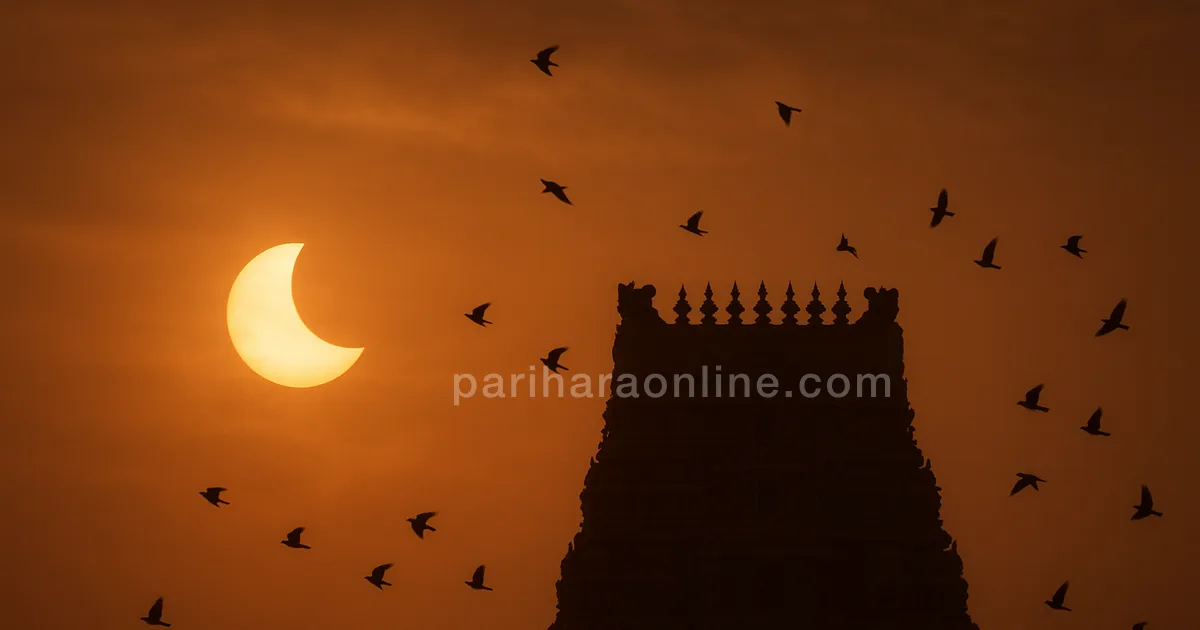
It was too late to kill him. The head, immortal, became Rahu. The body, also immortal, became Ketu. And ever since, the story says, Rahu chases the Sun and the Moon to swallow them in revenge. That is an eclipse. Because he has no body, they slip out through his throat again.
The story says a demon was punished. The story is really about craving and letting go. Rahu is a head with no stomach: pure appetite that can never be satisfied. Ketu is a body with no head: action without ego, sometimes without direction. Every human being carries both.
What is Rahu Ketu dosha in a birth chart?
Rahu and Ketu are always exactly opposite each other, so they form an axis across the chart. Each spends roughly a year and a half in a sign, moving backwards through the zodiac, and people often watch the Rahu Ketu transit effects when that axis shifts.
In Jyotish, Rahu is seen as the pull toward the new, the foreign, the forbidden, the more. Ketu is seen as the pull away: detachment, past-life habit, spiritual insight, and sometimes loss. A dosha, which simply means a flaw or an affliction, is when astrologers judge that this axis sits in a place that may create difficulty, for example with the Sun or Moon, or in the houses tied to marriage or health. A related pattern, where all the planets fall on one side of the axis, is covered in kala sarpa dosha.
Appetite and detachment, then. One pole wants everything; the other wants nothing. The dosha is a warning sign that one of the two may be louder than it should be. It is not a verdict on a person.
Rahu Ketu dosha remedies in tradition
Tradition's responses to Rahu and Ketu are old and fairly consistent. Durga is prayed to for Rahu, since she is the one who faces and subdues demons. Ganesha is prayed to for Ketu, since he is the one who removes obstacles, and whose own story is about a head. Some families keep Tuesday or Saturday prayers, and some chant the Hanuman Chalisa on Saturdays.
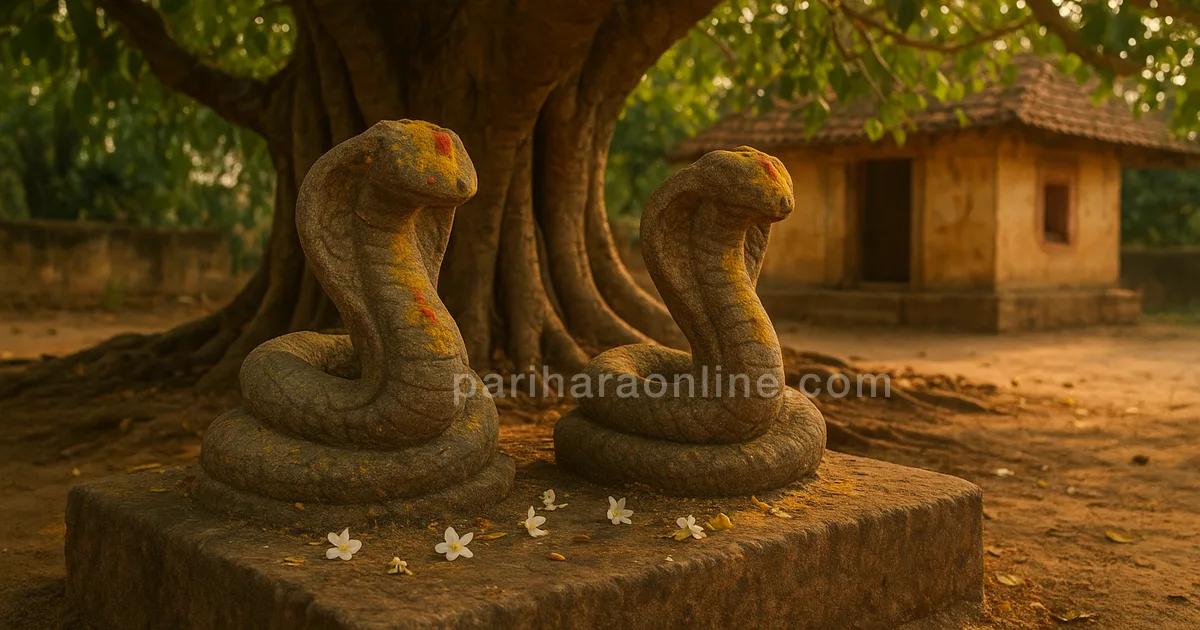
Because Rahu and Ketu are pictured as serpents, many sarpa dosha remedies involve serpent-linked temples. The best known is Sri Kalahasti in Andhra Pradesh, where the Sri Kalahasti Rahu Ketu pooja is performed daily for devotees seeking relief. The nine grahas also have shrines of their own in most South Indian temples, and the guide to Navagraha temple worship shows how to walk around them with attention.
And there is the quiet inner work, which may be the oldest remedy of all: noticing what you chase and asking whether you actually want it. Tradition also watches Rahu's daily slot, the Rahu kalam, when it chooses times for new beginnings.
Every chart has both
Here is the reframe. Every chart has Rahu and Ketu. Nobody escapes the axis, because nobody escapes the tension between wanting and letting go. The two shadows are not enemies stationed in your life. They point, very precisely, to what you are chasing and what you may be ready to release. Read them that way, and a frightening word becomes a useful question.
Questions people ask
What are Rahu and Ketu in astrology?
Rahu and Ketu are the north and south lunar nodes, mathematical points where the Moon's orbit crosses the Sun's apparent path. They cause eclipses when the Sun or Moon sits near them. Vedic astrology counts them among the nine grahas as shadow planets, with Rahu linked to desire and ambition and Ketu to detachment and spirituality.
What is Rahu Ketu dosha?
Astrologers use the term when Rahu or Ketu sits in positions considered sensitive, for example near the Moon, in the houses of marriage or family, or when all planets fall between them, called kala sarpa. Tradition connects such placements with delays or restlessness. Interpretation varies widely between astrologers, so one label should never be read alone.
Why do people go to Sri Kalahasti for Rahu Ketu pooja?
Sri Kalahasti in Andhra Pradesh is a Shiva temple whose legend includes a serpent among its devotees, and it is traditionally regarded as the foremost place for Rahu Ketu and sarpa dosha parihara pooja. Devotees perform the ritual there, or book it to be done on their behalf, as a focused act of prayer.
Enjoying this?
To get more Rahu Ketu posts like this, subscribe for free.
Written by
Reads the old stories for what they still mean
Hariharan writes about the myths, symbols and festival stories that most of us grew up hearing but were rarely asked to think about. He tells the story first, then asks what it is really about, and leaves the conclusion to you.