Kala Sarpa Dosha: What It Means and What Helps
Kala sarpa dosha meaning, told gently: what astrologers mean when every planet sits between Rahu and Ketu, the common worries, and what tradition says helps.
· 4 min read
In short
Kala sarpa dosha is the name astrologers give when all seven visible planets fall on one side of the Rahu-Ketu axis in a birth chart.
It is not described in the oldest classical Jyotish texts, and astrologers differ on its weight, so it should never be read in isolation.
Traditional responses include Rahu Ketu parihara pooja, serpent worship and Shiva prayers, done as devotion rather than as fear.
A friend forwarded me a screenshot one evening. Somebody had run her birth details through an app, and the result, in bold red letters, said: "You have kala sarpa dosha." Her evening was ruined, and for a while so was mine. The term sounds frightening. But kala sarpa dosha means something far narrower and calmer than that red text suggested: it is a pattern astrologers notice when all seven visible planets fall on one side of the Rahu-Ketu axis in a chart. It is one feature among many, and astrologers do not agree on its weight.
Kala sarpa dosha meaning: the serpent in the chart
"Kala" means time, and "sarpa" means serpent. In Jyotish, Vedic astrology, Rahu and Ketu are pictured as the head and tail of a serpent, always exactly opposite each other. Their story, of a demon who drank the nectar of immortality and was cut in two, is told in Rahu Ketu dosha explained.
When the Sun, Moon, Mars, Mercury, Jupiter, Venus and Saturn all sit on one side of that axis, astrologers say the chart is hemmed in by the serpent. That is the full version. If one planet sits outside the axis, many call it a partial version, and some do not count it at all.
People ask how to check kala sarpa dosha. The honest answer is that anyone can check it by looking at a chart, but what it means depends entirely on the rest of the chart. That is where astrologers disagree. Some treat it as significant. Others consider it minor. Several respected ones do not use it at all.
Is kala sarpa dosha as serious as people say?
When my friend calmed down, we looked into it together, and a few things helped.
First, kala sarpa dosha is not described in the oldest classical texts of Jyotish. It is a later idea, popular in recent generations, which is part of why astrologers weigh it so differently. Second, a large number of people carry some version of it, and they live ordinary lives: they marry, work, raise children, grow old. Third, and most important, no serious astrologer reads one feature of a chart on its own. A single pattern never decides a life.
The kala sarpa dosha effects people describe, such as delays, restlessness, a sense of effort not being rewarded, are real experiences. But they are also ordinary human experiences. Whether you believe astrology describes them or not, the question of what is real in astrology deserves a calm look, and is astrology real offers one.
There is a verse in the Bhagavad Gita that I read to my friend that night. Krishna tells Arjuna that heat and cold, pleasure and pain, come from the contact of the senses with the world; they arrive and they leave, they do not last, so bear them patiently. It is not a verse about astrology. It is a verse about labels, and weather, and how quickly both pass.
What tradition says helps
If you want to respond to it, tradition has calm answers, and none of them requires fear.
- Rahu Ketu parihara, a remedial pooja. This is performed at serpent-linked temples, most famously Sri Kalahasti, where devotees pray for the axis to settle.
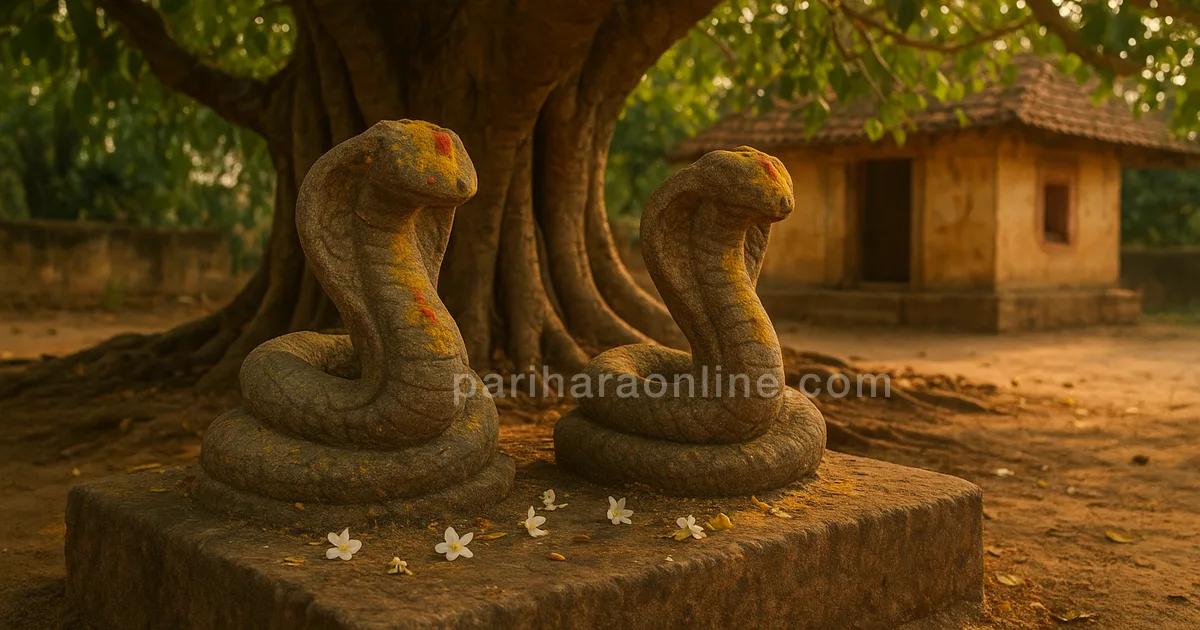
- Naga worship on Panchami. The fifth day of the lunar fortnight, especially Naga Panchami in the monsoon month of Shravana, is traditionally set aside for serpent deities, with milk offered at an anthill or a serpent stone.
- A daily Om Namah Shivaya. Shiva wears the serpent as an ornament. The five-syllable chant, explained in the meaning of Om Namah Shivaya, is a way of keeping that image close.
- Honest work on restlessness. If the chart points to restlessness, work on restlessness. Sleep, routine, one thing finished before the next begins.
The nine grahas also have their own shrines in most temples, and a slow walk around them, described in the guide to Navagraha temple worship, is a gentle practice for anyone who feels unsettled by a reading.
Before you panic at a label
My friend did eventually sit with an astrologer who read her whole chart. Kala sarpa dosha came up for about two minutes out of an hour. They spent far longer on her career and on a marriage question she had been carrying, the sort of worry addressed in delay in marriage remedies.
So here is the one thing to carry into your week. If a label frightens you, ask for the whole chart to be read before you believe any single line of it. And in the meantime, take one small calming practice into your days: a lamp, a chant, ten quiet minutes before sleep.
Questions people ask
What is kala sarpa dosha?
Kala sarpa dosha, literally the serpent of time, is said to occur when the Sun, Moon, Mars, Mercury, Jupiter, Venus and Saturn all sit between Rahu and Ketu in a birth chart. If even one planet falls outside that arc, many astrologers call it partial or cancelled. Its interpretation varies considerably between schools of astrology.
What are the effects of kala sarpa dosha?
Tradition associates kala sarpa with delays, repeated obstacles, restlessness or a sense that effort does not show results, sometimes in marriage or career. These are interpretations, not certainties. Many successful people have the configuration. A good astrologer weighs the whole chart, the running dasha and the strength of other planets before saying anything about effects.
What are the traditional remedies for kala sarpa dosha?
Common remedies include Rahu Ketu or sarpa dosha parihara pooja at temples such as Sri Kalahasti, offerings to Naga shrines on Naga Panchami, chanting Om Namah Shivaya, and Durga worship. Families often combine a temple pooja with a simple daily practice. Tradition offers these as prayer and intention, not as guaranteed removal.
Enjoying this?
To get more Rahu Ketu posts like this, subscribe for free.
Written by
The Sunday column: festivals and rituals meeting ordinary weeks
Manikandan writes the Sunday column, where festivals and rituals meet commutes, hospital corridors and video calls with parents far away. Each piece closes with one small thing to carry into the week ahead.