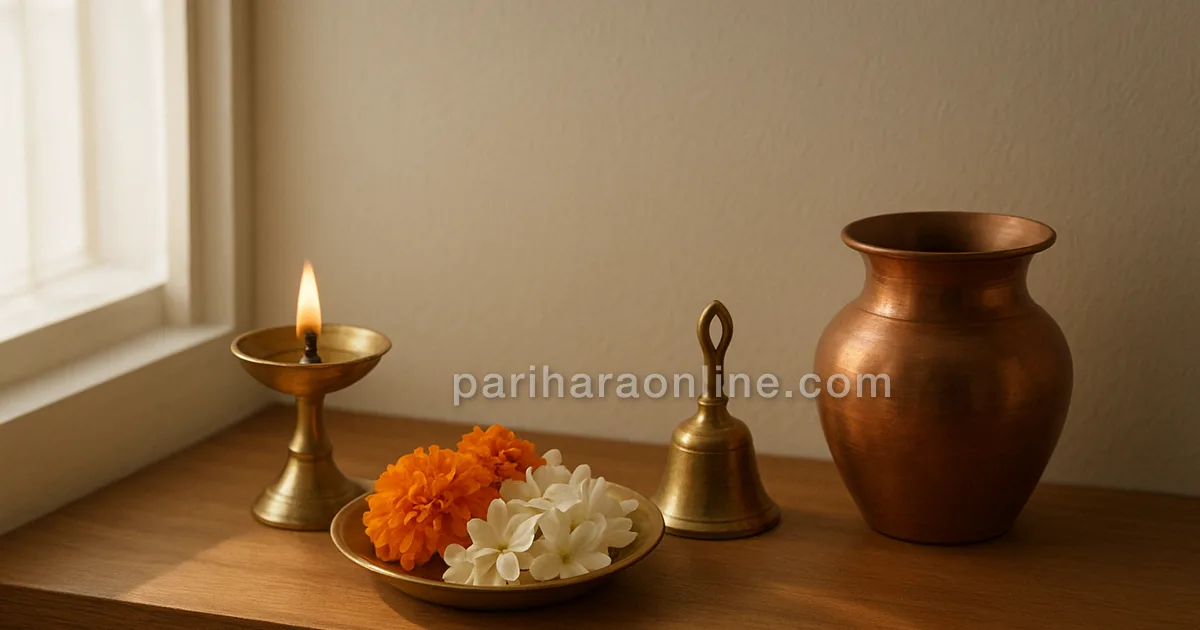
Daily Puja at Home: A Five-Minute Routine for Mornings
A daily puja at home in five minutes for busy mornings: lamp, a name, a flower, a breath and one line of prayer, so the day starts with you and not your inbox.
· 4 min read
In short
A five-minute daily puja can be complete: light a lamp, offer a flower or water, say the deity's name, breathe, and speak one line of prayer.
In the Bhagavad Gita, Krishna says a leaf, a flower, a fruit or water offered with love is accepted; length was never the point.
Doing the puja before picking up your phone turns five minutes into a daily anchor rather than one more task.
The alarm at six. Lunches packed by half past. The school run, the traffic on the ring road, the first meeting at nine. My grandmother in Thanjavur did her puja for an hour every morning, with a brass bell and a list of names longer than my arm. Mine takes five minutes, and it still holds the day together. A daily puja at home can be complete in that time: light a lamp, offer a flower or a spoon of water, say the deity's name, take three breaths and speak one line of prayer. That is all. Here is how I do it, and why I stopped feeling guilty that it is short.
A daily puja at home in five minutes
This is the routine. It fits between brushing your teeth and putting the kettle on.
- Wash your hands and face. If you have bathed, better, but do not wait for a perfect morning.
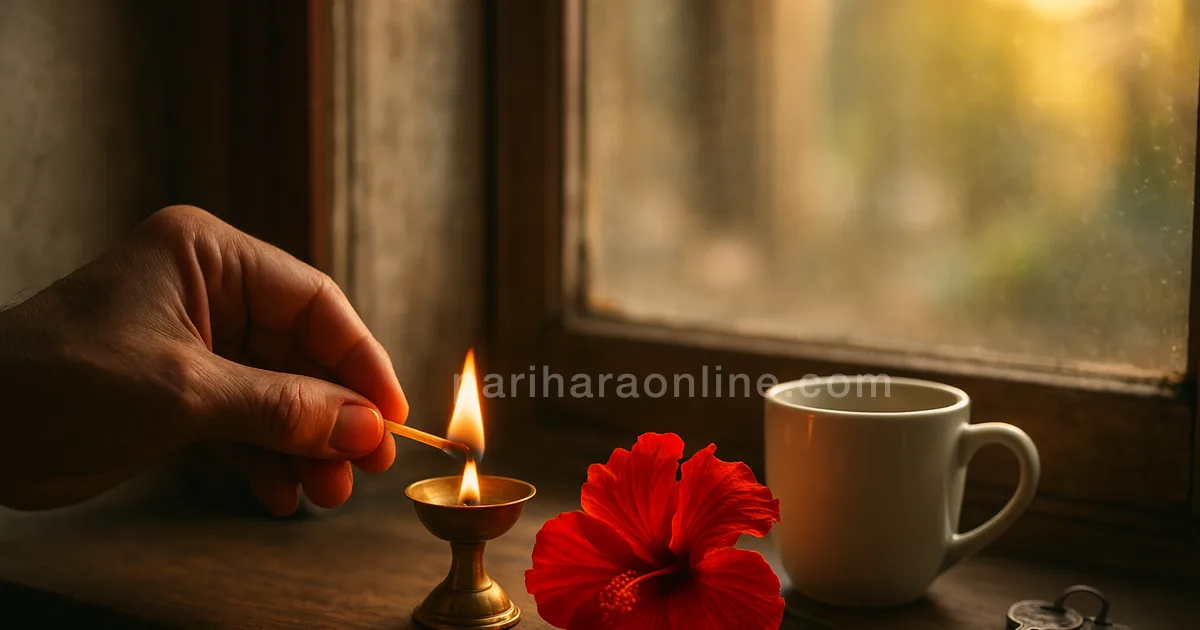
- Light the lamp. A small brass lamp with the wick already set, or a tea-light in a holder. It should take seconds. If you have a small puja corner in your apartment, keep the matches right there.
- Offer something. A single flower, a few petals, or just a spoonful of water at the deity's feet.
- Say the name. Your family deity, Ganesha, Shiva, the Goddess, Krishna. "Om Gam Ganapataye Namah" or "Om Namah Shivaya", three times.
- Three breaths. Slow ones. Let the shoulders fall.
- One line of prayer. A shloka if you know one, a short verse of praise. Or one sentence of your own: what you are grateful for, or what you need help with today.
That is a quick puja for working people, and it is enough. If you ever want to expand it into a fuller sequence on a weekend, puja at home, step by step shows how.
Is a short puja enough?
For a long time I thought the answer was no. My grandmother's hour felt like the real thing and my five minutes felt like a shortcut. Then my father, of all people, quoted the Bhagavad Gita to me over a bad phone line.
In chapter nine, Krishna says: whoever offers me a leaf, a flower, a fruit or a little water with love, I accept it. Patram pushpam phalam toyam. A leaf. A flower. A fruit. Water. No mention of how long. No mention of how many names, or whether you had time to bathe. The measure is love, which is to say attention.
My grandmother's hour and my five minutes are the same act at different lengths. Her life had room for an hour. Mine has room for five minutes. The Gita does not seem troubled by the difference, so I have tried not to be either. On festival days, I stretch it out. On ordinary days, a short daily prayer done every day is what keeps me steady.
Keeping it going on hard days
The hardest thing about a daily puja is not doing it. It is doing it on the morning when the baby was up at three, or the day after a long flight.
Before the phone. Everything changes if you light the lamp before you look at your phone. Once the inbox opens, the morning belongs to someone else.
Make the lamp fast. A lamp you can light in five seconds gets lit. A lamp that needs cleaning and fresh wicks every morning does not.
When you miss a day. Start again the next day, without drama. Tradition values steady return far more than a perfect record. If mornings are impossible, light it in the evening instead.
The sleepy version. Some mornings, I only light the lamp and say one name. It still counts. There are gentler ways to find more time too; waking early in brahma muhurta is one I am still learning.
If the practice starts to feel empty, it sometimes helps to understand what offering really means. The column on what the homam fire teaches about letting go changed how I think about the flower I put down each morning.
One small thing for this week
Light the lamp before you check your phone. Every morning, for seven days. Nothing else needs to change. Then notice what shifts: in the first hour, in your temper at the traffic light, in how the day feels when it started with you and not your inbox.
Questions people ask
Is a 5 minute puja enough?
Many traditional teachers say yes. The Bhagavad Gita, chapter nine, speaks of a leaf, a flower, a fruit or water offered with devotion being accepted. A short, sincere daily puja done regularly is often more sustaining than a long ritual done occasionally. On festival days you can always extend it.
What is a quick puja for working people?
Wash your hands and face, light a lamp, offer a flower or a little water, say the deity's name or a short mantra such as 'Om Namah Shivaya' or 'Om Gam Ganapataye Namah', take three slow breaths and state one intention for the day. The whole sequence takes about five minutes.
What should I do if I miss my daily puja?
Simply resume the next day, without guilt. Tradition values steady return more than a perfect record. If you are travelling or unwell, a mental puja, imagining the lamp and offerings while saying the name, is accepted in many traditions. Some people light the lamp in the evening if the morning slipped by.
Enjoying this?
To get more Daily Practice posts like this, subscribe for free.
Written by
The Sunday column: festivals and rituals meeting ordinary weeks
Manikandan writes the Sunday column, where festivals and rituals meet commutes, hospital corridors and video calls with parents far away. Each piece closes with one small thing to carry into the week ahead.